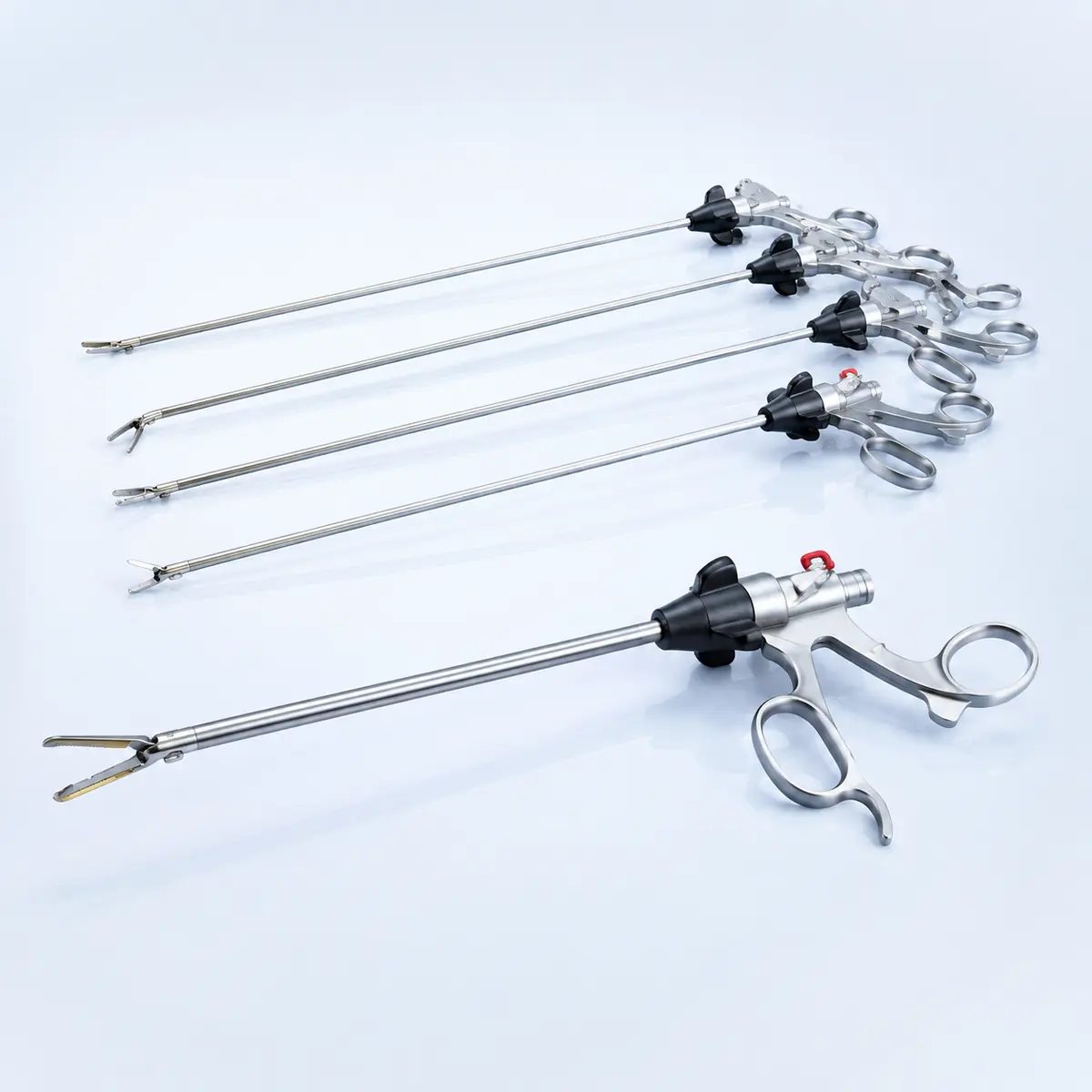
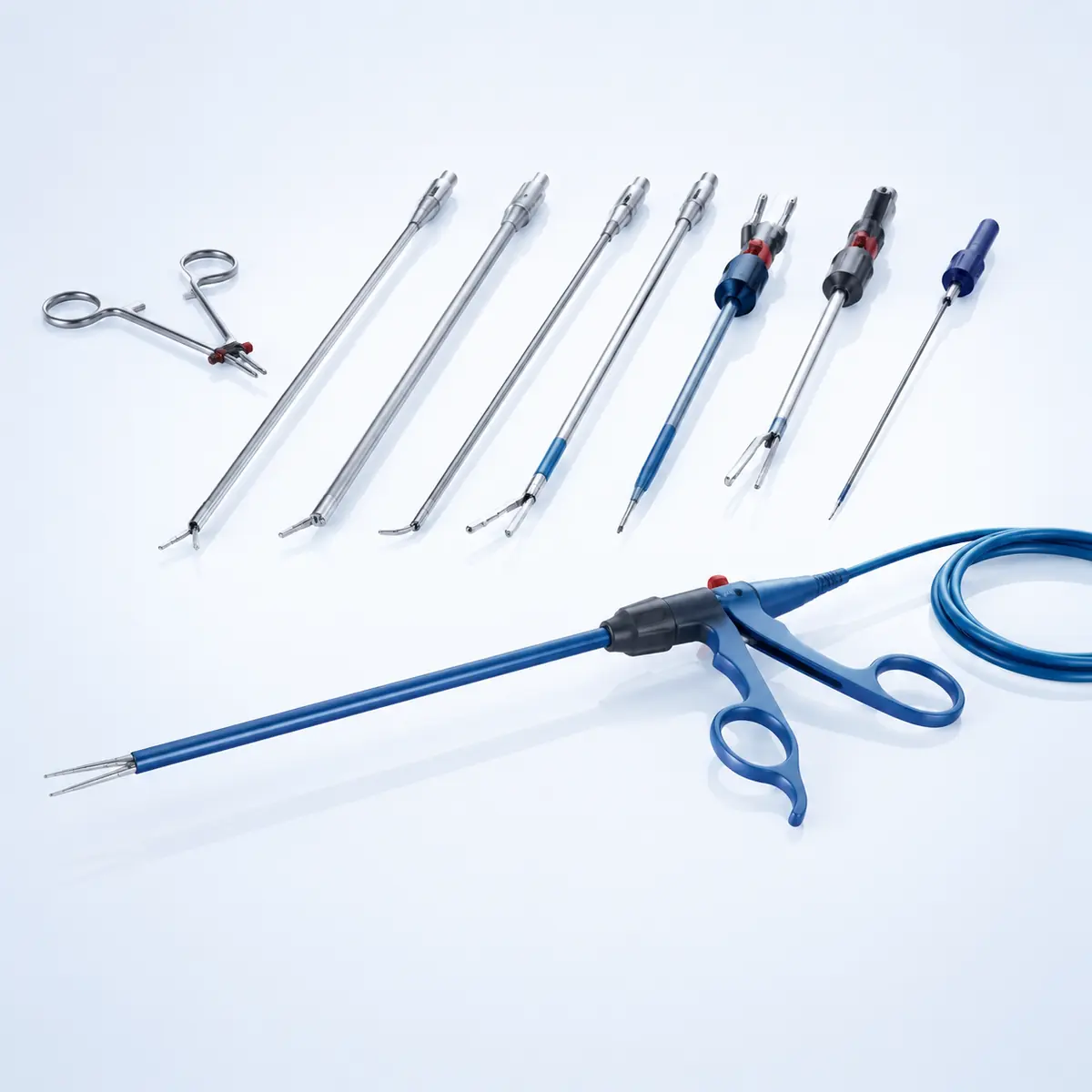
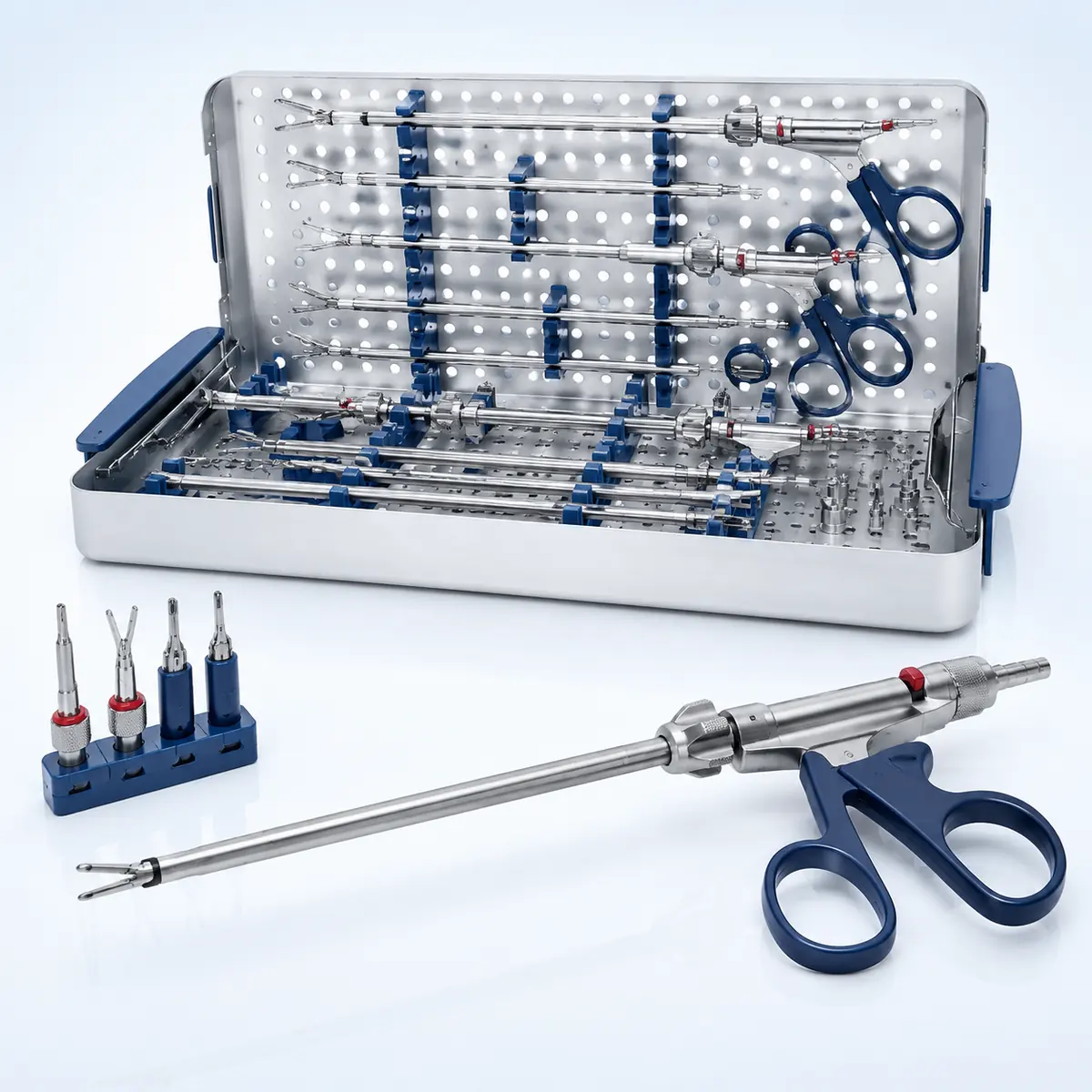
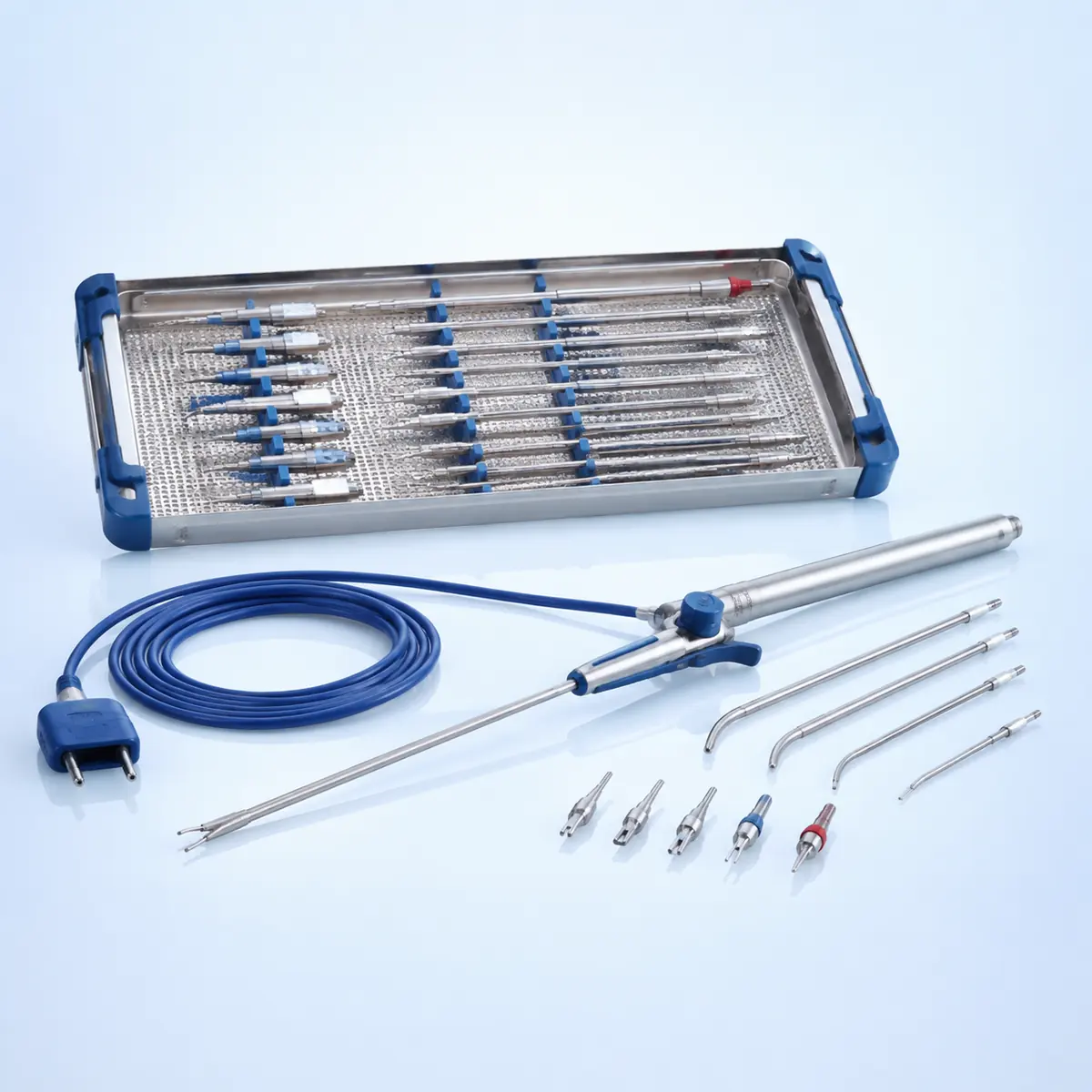
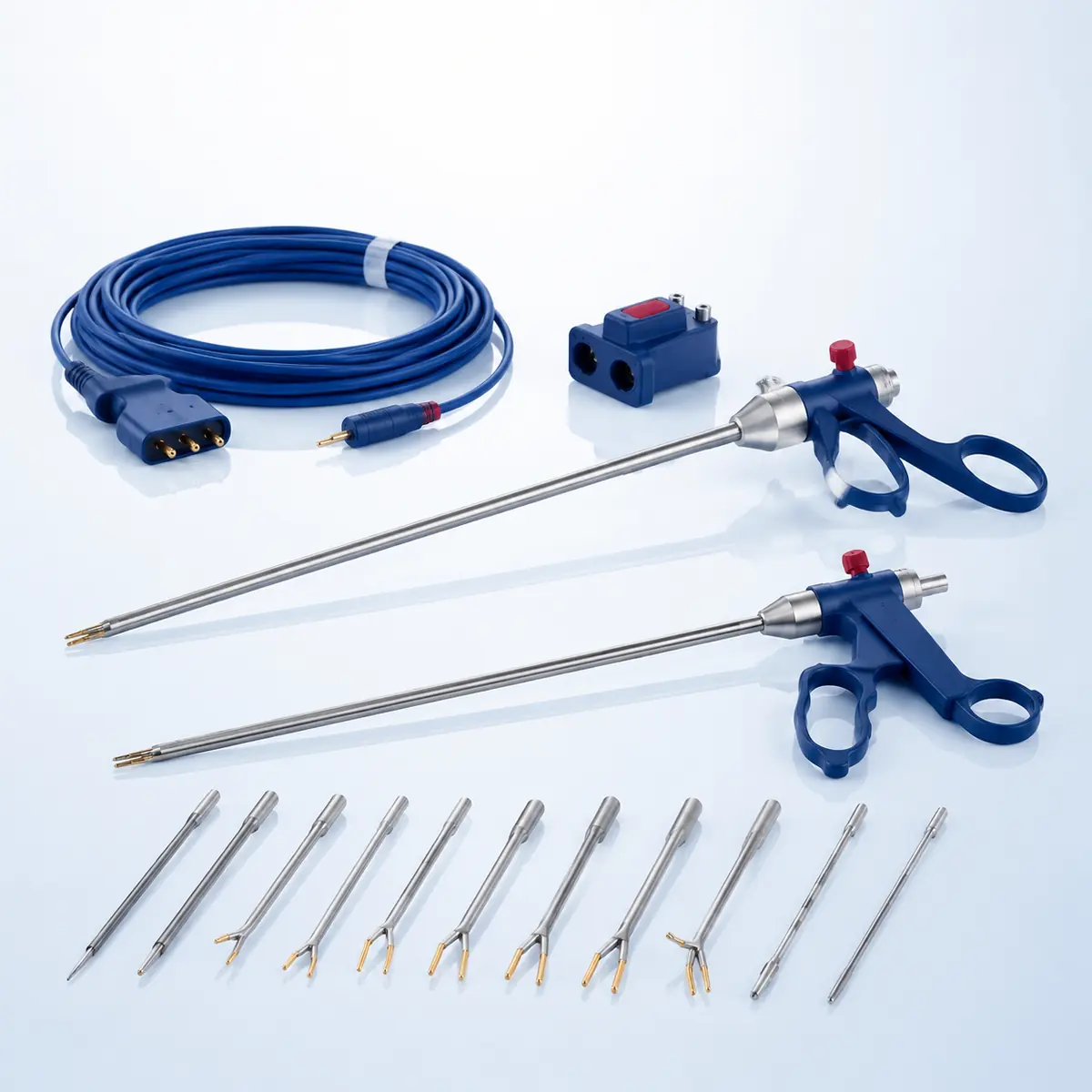
Bharat Surgical supplies reusable laparoscopic bipolar instruments for grasping, dissection and controlled bipolar electrosurgical applications. The range includes Maryland, straight, fenestrated and Ruby-pattern forceps, bipolar hooks, U-handle and X-handle options, double-action instruments and compatible bipolar handles. Published models are primarily available with 5 mm shafts and working lengths around 330–340 mm. Instrument selection must be based on the required jaw pattern, handle design, trocar size, generator model, bipolar output, cable connector and product-specific electrical rating.
These instruments are intended for use by qualified healthcare professionals. Product information does not replace the instrument, cable or electrosurgical generator instructions for use.
Laparoscopic bipolar instruments are minimally invasive surgical instruments in which the two electrical poles are incorporated into the working jaws or tip. When activated through a compatible electrosurgical generator, electrical energy passes between these poles through the tissue positioned at the working end.
Because the active circuit is concentrated between the two electrodes, a separate monopolar patient-return electrode is generally not part of a standard bipolar circuit. However, the generator manufacturer’s instructions must always be followed, especially when a procedure or platform uses more than one electrosurgical mode.
Laparoscopic bipolar instruments may be used for functions such as:
The final instrument and energy settings must be selected by the responsible clinical team according to the procedure, generator instructions and product-specific IFU.
Instrument selection must be based on the required jaw pattern, handle design, trocar size, generator model, bipolar output, cable connector and product-specific electrical rating.
Every clip applicator must be matched with the exact clip brand, size and cartridge configuration for which it has been designed.
Read More
Bharat Surgical offers reusable Bissinger-type laparoscopic bipolar forceps for grasping, dissecting and bipolar coagulation during minimally invasive surgical procedures.
Read More
Bharat Surgical offers reusable ENT bipolar forceps for controlled tissue handling and bipolar coagulation in ear, nose, throat and selected head-and-neck surgical procedures.
Read More
Bharat Surgical offers reusable laparoscopic bipolar forceps with U-handle and X-handle configurations for controlled tissue grasping, manipulation and bipolar coagulation during minimally invasive procedures.
Read More| Instrument | Published configuration | Handle or action |
|---|---|---|
| Laparoscopic Bipolar Maryland | 5 mm × 330 mm | Standard handle; Maryland jaw |
| Bipolar Forceps – U Handle | 5 mm × 330 mm | U-handle configuration |
| Bipolar Forceps – X Handle | 5 mm × 330 mm | X-handle configuration |
| Straight Bipolar Forceps | 5 mm × 330 mm | Standard handle |
| Double-Action Bipolar Instrument | Dimensions on request | Double-action jaw mechanism |
| Laparoscopic Bipolar Hook | 5 mm × 330 mm | Standard insulated handle |
| Stainless-Steel Bipolar Hook | 5 mm × 340 mm | Standard handle |
| Fenestrated Bipolar Forceps | 5 mm range listed | Fenestrated jaws |
| Ruby-Pattern Bipolar Forceps | 5 mm range listed | Specialised jaw pattern |
| Laparoscopic Bipolar Handle | 5 mm/330 mm configuration listed | Standard or ring-type handle |
The above range consolidates models published across Bharat Surgical’s laparoscopic bipolar forceps, laparoscopic instruments and laparoscopy handles listings. Certain catalogue fields differ between listings; the final quotation and approved technical datasheet should control the order.
| Parameter | Published range or description |
|---|---|
| Instrument category | Reusable laparoscopic bipolar instruments |
| Common shaft diameter | 5 mm |
| Published working lengths | Approximately 330 mm and 340 mm, depending on model |
| Jaw patterns | Maryland, straight, fenestrated and Ruby-pattern options |
| Working-end options | Bipolar forceps and bipolar hooks |
| Handle options | Standard, ring, U-handle and X-handle configurations |
| Jaw action | Single-action and double-action options, subject to model |
| Main construction | Stainless-steel components with insulated handle or shaft elements |
| Published connector | Storz-type bipolar cable connector on listed models |
| Reusability | Reusable models listed |
| Sterile supply status | Must be confirmed for the selected product code |
| Cable | Confirm whether included or ordered separately |
| Generator compatibility | Must be confirmed against the generator brand, model and bipolar output |
| Reprocessing | Follow the product-specific validated IFU |
| Packaging | Confirm individual or bulk packaging with quotation |
Some online catalogue fields associated with these products mention values such as “400 W,” “Pure Cut” or “Blend.” These entries should not be treated as validated operating limits for a bipolar instrument because those terms may relate to different electrosurgical classifications or copied catalogue fields.
Before use or procurement, obtain written confirmation of:
Do not select generator settings from a general website listing.
Maryland-pattern forceps normally have tapered, curved jaws suitable for fine grasping and dissection. Procurement documents should state whether the required instrument is primarily intended for grasping, dissection, coagulation or a combination of these functions.
Straight jaws provide a direct working orientation. The buyer should confirm the tip width, serration pattern, jaw length and whether the model is atraumatic or intended for firmer grasping.
Fenestrated jaws provide a broader contact area and an opening within the jaw profile. The exact fenestration, jaw length and closing pressure vary between designs and should be verified with a product drawing or sample.
Ruby-pattern forceps are listed within the 5 mm bipolar range. Because naming conventions may differ between manufacturers, buyers should request a clear product image, jaw drawing and catalogue code before approving an order.
A bipolar hook provides a hook-shaped working end for targeted manipulation and bipolar energy application. Hook direction, curvature, exposed electrode area and insulation configuration must be confirmed for the selected model.
| Handle type | General characteristic | What the buyer should confirm |
|---|---|---|
| Standard or ring handle | Familiar finger-operated configuration | Locking mechanism, rotation and jaw action |
| U handle | U-shaped ergonomic configuration | Grip size, jaw control, rotation and cable position |
| X handle | X-pattern operating mechanism | Opening force, hand fit and jaw movement |
| Double-action handle | Both jaws may move during operation | Jaw alignment, closing pressure and intended application |
| Detachable handle | Handle and insert may separate if designed as a modular system | Approved insert, assembly procedure and reprocessing method |
Handle preference should be evaluated together with jaw geometry and instrument balance. A preferred handle shape alone does not establish generator or cable compatibility.
| Feature | Single-action design | Double-action design |
|---|---|---|
| Jaw movement | One jaw may move against a fixed jaw | Both jaws generally move |
| Instrument profile | May offer predictable fixed-jaw positioning | May provide centred jaw closure |
| Cleaning considerations | Inspect the fixed jaw and hinge | Inspect both moving jaws and joint surfaces |
| Selection basis | Surgeon preference and intended task | Surgeon preference, access and jaw behaviour |
| Procurement requirement | Confirm exact mechanism | Confirm that “double action” applies to the quoted model |
The clinical team should evaluate the preferred jaw action using the approved product documentation or sample.
| Point | Bipolar instrument | Monopolar instrument |
|---|---|---|
| Electrical poles | Both poles are incorporated at the working tip or jaws | Active electrode is at the instrument; current returns through a separate pathway |
| Patient-return electrode | Generally not part of a standard bipolar circuit | Normally required for conventional monopolar operation |
| Typical laparoscopic forms | Forceps, graspers, dissectors and bipolar hooks | L-hook, spatula, scissors and electrodes |
| Cable requirement | Bipolar cable compatible with instrument and generator | Monopolar cable and matching generator connection |
| Generator mode | Approved bipolar mode | Approved monopolar cut or coagulation mode |
| Interchangeability | Not interchangeable with monopolar accessories unless specifically designed and documented | Not interchangeable with bipolar accessories |
Instrument type, cable, generator socket and mode must match. A physical connection alone does not prove electrical compatibility.
Laparoscopic bipolar forceps and vessel-sealing instruments should not be treated as equivalent products.
| Feature | Standard bipolar forceps | Vessel sealer with cutter |
|---|---|---|
| Primary design | Grasping, dissection and bipolar coagulation | Platform-controlled vessel or tissue-bundle sealing |
| Energy control | Depends on compatible bipolar generator and instrument rating | Usually relies on a validated generator and sealing algorithm |
| Mechanical cutter | Normally absent | May include an integrated cutter |
| Compatibility | Cable and bipolar-output compatibility required | Generator-platform and device-specific compatibility required |
| Procurement documentation | Instrument, cable and generator information | Instrument, cutter, seal capability and generator-platform validation |
A standard bipolar instrument must not be represented as a vessel sealer unless the specific product has documented sealing capability and compatible platform validation.
Bipolar instruments are components of an electrosurgical system. Compatibility must be established across the complete connection path:
For every order, confirm:
Bharat Surgical listings identify a Storz-type connector on several models, but this does not by itself establish compatibility with every generator or every cable carrying a similar connector.
As an example of system-specific compatibility, Olympus states that its reusable bipolar forceps are designed for compatibility with specified Olympus generators. This illustrates why the instrument, generator and cable should be confirmed as one documented system rather than matched by appearance alone. See the manufacturer’s radiofrequency and bipolar instrument information.
The FDA also addresses the importance of preventing unintended electrical connections involving electrosurgical leads and cables in its electrode lead-wire and patient-cable guidance.
No. “Storz connector” describes the published connector configuration on several instruments, but compatibility still depends on:
Buyers should exchange clear photographs, connector dimensions and product codes when the generator or existing cable is not available for physical verification.
Most listed instruments use a 5 mm shaft and are intended for a compatible laparoscopic port. Before ordering, verify:
Nominal dimensions do not replace physical compatibility checks, particularly when instruments and trocars are sourced from different manufacturers.
Qualified personnel should inspect the instrument and cable according to the applicable IFU before each use.
Check the following:
An instrument or cable showing insulation failure, connector damage, distorted jaws or uncertain electrical integrity should be removed from service and evaluated under the facility’s maintenance procedure.
Reusable laparoscopic bipolar instruments must be reprocessed only according to the validated instructions supplied for the selected model.
A facility’s process may include:
Do not assume that the instrument and bipolar cable use identical cleaning or sterilisation parameters. Obtain the cable manufacturer’s instructions separately.
For technically complete comparison, the tender or enquiry should include:
Evaluation should be based on the complete quoted configuration rather than the instrument name alone.
Dealer and distributor enquiries may request:
Regulatory, registration and labelling requirements vary by market and should be agreed before order confirmation.
"Reusable Laparoscopic Bipolar Instrument, 5 mm diameter, approximately 330 mm working length, with [Maryland/straight/fenestrated/Ruby/hook] working end, [standard/U/X] handle, insulated shaft, stainless-steel working components and [single/double] action; compatible with [generator manufacturer and model] through the specified bipolar cable and connector. Instrument, cable, electrical rating, sterile-supply status and validated reprocessing instructions to be confirmed by the supplier."
A separate BOQ line should be created for the bipolar cable when it is not explicitly included with the instrument.
Final specifications, quality documentation, certifications and regulatory status should be verified for the exact quoted product and destination market.
Find technical, reprocessing, ordering, and size compatibility answers for the Bharat Surgical Bipolar Instruments range.
It is a laparoscopic instrument with both electrical poles incorporated at its jaws or working tip. It connects to a compatible electrosurgical generator through an approved bipolar cable.
Depending on the model, they may be used for grasping, dissection, tissue manipulation and bipolar coagulation by qualified surgical professionals.
A bipolar instrument passes current between two electrodes at its jaws or tip. A conventional monopolar instrument uses an active electrode and a separate patient-return pathway.
A separate monopolar return pad is generally not part of a standard bipolar circuit. The generator instructions must still be followed because systems and procedural configurations differ.
The published Bharat Surgical range primarily includes 5 mm laparoscopic bipolar instruments.
Published configurations include approximately 330 mm and 340 mm lengths, depending on the model. The exact usable length should be confirmed.
Published options include Maryland, straight, fenestrated and Ruby-pattern jaws, along with bipolar hooks.
It is a bipolar forceps with tapered, curved Maryland-pattern jaws generally selected for fine grasping or dissection. Exact jaw geometry varies by model.
It has a broader jaw pattern with an opening or fenestration in the working end. Buyers should confirm the fenestration, jaw length and serration design.
It is a named jaw configuration within the published 5 mm bipolar range. A product image or drawing should be approved because naming conventions can differ.
Yes. Published listings include a 5 mm × 330 mm bipolar hook and a stainless-steel bipolar hook with a listed length of approximately 340 mm.
They use different operating-handle geometries. Selection depends on hand fit, jaw control, movement and user preference rather than electrical compatibility alone.
It is a design in which both jaws generally move during opening and closing. The mechanism should be confirmed for the specific product code.
Some configurations may include rotation, but this should not be assumed for every model. State the rotation requirement in the enquiry.
Detachable handle or insert configurations may be available. Buyers must confirm the approved handle, insert, assembly method and reprocessing procedure.
Several listed models specify a Storz-type cable connector. The exact connector and cable code must be verified before ordering.
No. Physical fit does not establish compatibility. Pin layout, cable construction, electrical rating, generator socket and approved operating mode must all match.
Not necessarily. The quotation should explicitly state whether the bipolar cable is included or must be ordered separately.
No universal compatibility should be assumed. Provide the generator manufacturer, model and socket details for verification.
Only the setting permitted by the generator instructions and the product-specific instrument IFU should be used. A website description should not determine clinical settings.
No. That field should not be treated as a validated bipolar-instrument rating without product-specific technical confirmation.
Standard bipolar forceps should not be represented or used as a vessel sealer unless the exact product has documented sealing capability and generator-platform validation.
Standard bipolar forceps generally do not include an integrated cutter. Vessel sealers with cutters form a separate product category.
Not automatically. Confirm the trocar’s internal working channel, valve, seal, reducer arrangement and compatibility with the instrument’s insulated shaft.
Reusable options are listed. The exact reuse life, inspection criteria and reprocessing method must come from the selected product’s IFU.
Sterile-status fields vary between listings. The quotation must clearly state whether the selected product is supplied sterile or non-sterile.
Some published models are described as autoclavable. Use only the validated temperature, exposure time and cycle specified for the exact product.
Check for cracks, cuts, peeling, pinholes, discolouration and other damage according to the facility procedure and product IFU. Damaged instruments should be removed from service.
Inspect the cable insulation, bends, plugs, pins and strain-relief areas. A cable with cuts, crushing, loose contacts or connector damage should not be used.
Follow the product IFU. Hinges, serrations and electrode surfaces require careful cleaning, rinsing, drying and inspection without using an unapproved abrasive method.
Only if the instrument is specifically designed for disassembly and the IFU provides an approved method. Do not force apart a fixed instrument.
Only where compatibility is documented for the cable, instrument and generator combination. Similar-looking plugs are insufficient evidence.
Sample availability may be discussed for hospital, dealer or tender evaluation. Commercial terms, delivery and return conditions should be agreed in advance.
Yes, subject to product configuration, minimum quantity, documentation, destination market and commercial terms.
Send the instrument type, jaw pattern, handle, diameter, length, quantity, generator brand and model, cable requirement and delivery location.
Custom configurations may be discussed subject to technical feasibility, minimum quantity, validation and regulatory requirements.
The price of a laparoscopic bipolar instrument depends on: For an accurate quotation, send the required instrument type, quantity, generator brand and model, cable requirement and delivery location.
Factors Affecting Price: Jaw or tip design, Handle configuration, Single- or double-action mechanism, Complete or detachable construction, Shaft diameter and length, Cable inclusion, Connector type, Generator compatibility requirements, Packaging and sterile-supply status, Order quantity, Documentation and destination market, Customisation or private labelling