ISO 13485:2016 Certified
40+ Years of Excellence
600+ Products
Download Catalog
MANUFACTURER & SUPPLIER | B2B LAPAROSCOPIC INSTRUMENTS

Laparoscopic Vessel Sealer with Cutter
Manufacturer in India

Bharat Surgical manufactures and supplies reusable laparoscopic vessel sealers with an integrated cutting mechanism for hospitals, surgical centres, dealers, distributors and medical-equipment buyers. The published model combines a 5 mm laparoscopic shaft, straight working jaws and a mechanical cutter in one instrument. A vessel sealer with cutter must be evaluated as part of a complete electrosurgical system. Buyers should confirm the generator platform, approved vessel-sealing mode, cable, connector, maximum rated voltage, documented sealing capacity and reprocessing instructions before placing an order.

ISO 13485:2016 Certified
40+ Years Experience
Mumbai Warehousing
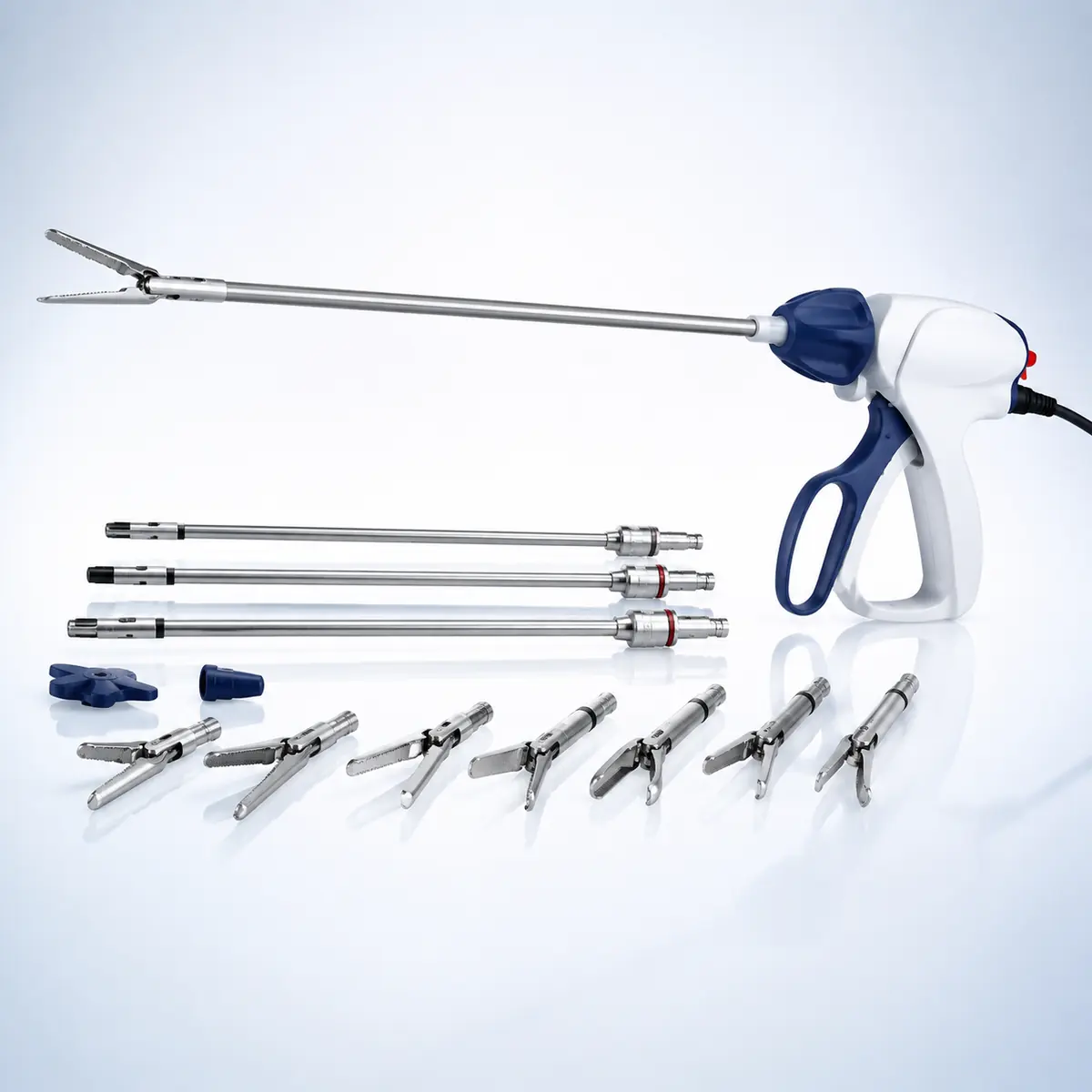
Laparoscopic Vessel Sealer with Cutter surgical instrument on a clean clinical blue background
Product Overview

What Is a Laparoscopic Vessel Sealer with Cutter?

A laparoscopic vessel sealer with cutter is an electrosurgical instrument designed to compress tissue between its jaws, apply compatible bipolar sealing energy and mechanically divide the sealed tissue using an integrated blade.

The instrument combines three key surgical functions:

Tissue Grasping & Compression

Allows the surgeon to securely hold, manipulate, and apply mechanical pressure to target tissue structures and vessels prior to energy delivery.

Bipolar Energy Sealing

Applies high-frequency electrical current through the jaws to thermally fuse the vessel walls, creating a permanent, leak-resistant autogenous seal.

Integrated Cutting

Features a trigger-activated mechanical blade that travels through the jaw channel to divide the sealed tissue safely without exchanging instruments.

Clinical Notice & Safety Guidance

The integrated cutter can reduce the need to exchange the vessel-sealing instrument for a separate laparoscopic scissor. However, sealing and cutting must be performed only according to the approved product and generator instructions.

Vessel Sealer with Cutter Details

Published Bharat Surgical Model

Parameter Published specification
Product Laparoscopic Vessel Sealer with Cutter
Instrument classification Bipolar forceps/cutting instrument
Jaw type Straight
Shaft diameter 5 mm
Published length 330 mm
Handle type Standard handle
Cable connector Storz-type connector listed
Main material Stainless steel
Additional construction Insulated components
Cutter Integrated cutting mechanism
Usage Laparoscopic and hospital use
Reusability Reusable model listed
Sterilisation Described as autoclavable
Country of origin Made in India
Generator compatibility Must be confirmed
Validated vessel-sealing diameter Not published; written confirmation required
Maximum rated voltage Not published; written confirmation required
Approved sealing mode Not published; written confirmation required
Cable inclusion Confirm with quotation
Sterile supply status Confirm with quotation

These details are based on Bharat Surgical’s published laparoscopic instrument range. One catalogue field also mentions “10 mm,” which conflicts with the detailed 5 mm shaft specification. The final approved drawing and quotation should therefore confirm both the shaft diameter and compatible trocar size.

Selection Guide

Information That Must Be Confirmed Before Ordering

The available listing establishes the basic mechanical configuration but does not provide every technical parameter required to evaluate a vessel-sealing system.

Request written confirmation of:

Exact catalogue or model number
Shaft diameter
Total and working length
Jaw length and width
Jaw opening
Seal length
Cut length
Cutter travel
Rotation angle
Single- or double-action jaws
Maximum validated vessel diameter
Approved tissue-bundle application
Maximum rated voltage
Approved generator mode
Compatible generator manufacturer and model
Generator-side cable connector
Instrument-side cable connector
Hand-switch or footswitch activation
Cable inclusion
Reusable-life or inspection criteria
Cleaning and sterilisation instructions
Sterile or non-sterile supply condition
Applicable quality and regulatory documentation

Procurement Notice: A general statement such as “compatible with bipolar cautery” is not sufficient for procurement of a vessel-sealing device.

Vessel Sealer with Cutter Details

How Does a Vessel Sealer with Cutter Work?

A vessel-sealing system generally combines controlled jaw pressure with bipolar electrosurgical energy. The tissue is held between the jaws, and the compatible generator delivers energy according to its approved vessel-sealing mode.

After the required seal cycle is completed and confirmed according to the system instructions, the integrated mechanical blade can be actuated to divide the tissue within the sealed area.

The complete process depends on:

Jaw design
Tissue compression
Electrode geometry
Generator output
Energy-control algorithm
Activation time
Tissue characteristics
Cutter alignment
Product-specific operating instructions

The presence of bipolar jaws and a cutter does not independently establish a validated vessel-sealing capability.

Product Comparison

Vessel Sealer with Cutter vs Standard Bipolar Forceps

Feature Vessel sealer with cutter Standard bipolar forceps
Primary function Sealing and mechanical division Grasping, dissection and bipolar coagulation
Integrated blade Yes, on the published model Normally absent
Energy requirement Approved sealing output or mode must be verified Compatible standard bipolar mode
Vessel capacity Must be documented for the exact device and generator Should not be assumed to have advanced vessel-sealing capacity
Jaw compression Designed as part of the sealing system Depends on the forceps design
Generator dependency Platform and mode compatibility are critical Generator and cable compatibility remain necessary
Procurement category Vessel sealer/divider Bipolar forceps or dissector
Use as a substitute Must not be substituted without technical approval Must not be represented as a vessel sealer without validation

Standard bipolar forceps should not be used or marketed as an advanced vessel sealer unless the specific instrument-generator combination has documented sealing capability.

Product Comparison

Vessel Sealer with Cutter vs Ultrasonic Device

Point Bipolar vessel sealer with cutter Ultrasonic surgical device
Energy principle Bipolar radiofrequency energy with jaw compression Mechanical ultrasonic vibration
Tissue division Integrated mechanical blade on this model Cutting effect created by the ultrasonic working end
Generator Compatible bipolar vessel-sealing platform Compatible ultrasonic generator
Cable and connector Bipolar system-specific connection Ultrasonic transducer and generator connection
Interchangeability Not interchangeable Not interchangeable
Selection Based on approved indication, platform and clinical preference Based on approved indication, platform and clinical preference

No claim of superiority should be made without product-specific comparative evidence.

Vessel Sealer with Cutter Details

Integrated Cutter

The cutter is a mechanical component that travels through or between the jaws to divide the sealed tissue. Before purchasing, confirm:

Whether cutter activation is independent of energy activation
Whether the blade is reusable or replaceable
Cutter travel length
Relationship between seal length and cut length
Blade-return mechanism
Lockout or activation sequence
Cleaning access around the cutter
Blade-inspection criteria
Replacement or repair availability
Reusable-life limitations

The cutter must move smoothly and return fully to its intended position. A damaged, blunt, misaligned or sticking cutter requires evaluation before further use.

Vessel Sealer with Cutter Details

Jaw Design and Tissue Compression

The published Bharat Surgical model lists straight jaws. Buyers should request a detailed jaw drawing covering:

Jaw length
Jaw width
Electrode length
Serration pattern
Tip profile
Maximum opening
Compression mechanism
Blade channel
Insulated and conductive areas
Rotation capability

Jaw pressure is part of the sealing system’s performance. It should not be modified, adjusted or repaired outside the manufacturer’s approved procedure.

Vessel Sealer with Cutter Details

What Vessel Diameter Can It Seal?

The validated maximum vessel diameter is not stated in the available Bharat Surgical listing. Therefore, this page does not claim a specific sealing capacity.

Although some other vessel-sealing systems publish capacities such as 5 mm or 7 mm, those values apply only to the exact instruments, generators and validated modes named by their manufacturers. They cannot be transferred to the Bharat Surgical model without supporting documentation.

The quotation or technical datasheet should state:

Maximum validated vessel diameter
Applicable tissue-bundle limitation
Compatible generator and sealing mode
Test or validation basis
Relevant warnings and exclusions

If these details are not available, the instrument should not be assumed to provide a particular vessel-sealing capacity.

Vessel Sealer with Cutter Details

Generator Compatibility Is Essential

A laparoscopic vessel sealer with cutter is one part of an electrosurgical system:

Approved generator and sealing mode
Compatible generator output socket
Approved bipolar cable
Instrument connector
Vessel-sealing jaws and cutter

For compatibility checking, provide:

Generator manufacturer
Exact generator model
Available vessel-sealing or bipolar mode
Photograph of the generator output socket
Existing cable product code
Generator-side cable connector
Instrument-side cable connector
Required activation method
Product-specific maximum voltage rating
Any generator software or platform requirement

Compatibility Advisory: Advanced vessel-sealing instruments can be platform-specific. For example, Medtronic publishes defined generator compatibility for its LigaSure Atlas laparoscopic sealer-divider, while Erbe identifies dedicated modes and compatible instruments for its VIO seal platform. These examples demonstrate why compatibility cannot be inferred only from the connector’s appearance.

Vessel Sealer with Cutter Details

Does the Storz-Type Connector Guarantee Compatibility?

No. The published instrument lists a Storz-type connector, but this description alone does not establish:

Generator compatibility
Pin compatibility
Correct output mode
Appropriate voltage rating
Energy-feedback capability
Vessel-sealing algorithm compatibility
Cable approval

A cable may physically connect while remaining unsuitable for the intended energy output. Compatibility should be documented by the supplier and confirmed against the generator manufacturer’s instructions.

Vessel Sealer with Cutter Details

Important Classification Check

The Bharat Surgical listing classifies the product as a bipolar forceps and cutting instrument. Before it is described in a tender as an “advanced vessel-sealing system,” the buyer should verify whether it is:

A reusable bipolar forceps with a mechanical cutter
A generator-controlled vessel-sealing instrument
Compatible with a dedicated sealing algorithm
Approved for a stated maximum vessel diameter
Supplied with a dedicated or standard bipolar cable

This distinction affects tender specifications, generator selection, clinical evaluation and product claims.

Vessel Sealer with Cutter Details

Shaft and Trocar Compatibility

The detailed listing identifies a 5 mm shaft with a length of approximately 330 mm. Before use with a trocar, confirm:

Actual maximum shaft diameter
Required trocar working-channel diameter
Clearance for insulated sections
Compatibility with the trocar valve and seal
Handle clearance outside the port
Jaw opening after insertion
Required reducer
Working length for the intended procedure
Freedom of rotation
Cable routing around the operating field

Because another catalogue field mentions 10 mm, the final model drawing should control the order.

Vessel Sealer with Cutter Details

Rotation and Handle Requirements

The published model has a standard handle, but the listing does not clearly establish the rotation angle or activation arrangement.

Buyers should specify whether they require:

Rotatable or fixed shaft 360-degree rotation
Hand activation
Footswitch activation
Independent cutter trigger
Ratcheted or non-ratcheted jaw closure
Ergonomic ring or lever handle
Right- and left-hand operation
Blade lock or return mechanism

Handle photographs and a physical sample can help hospitals evaluate usability before bulk procurement.

Product Comparison

Reusable vs Single-Use Vessel Sealers

Point Reusable instrument Single-use instrument
Reprocessing Required after every use Normally not reprocessed
Inspection Required before and after use Package integrity and pre-use inspection
Cutter maintenance Blade and mechanism require inspection New cutting mechanism with each device
Upfront cost Generally higher per instrument Repeated purchase cost
Lifecycle Depends on validated reuse and inspection criteria One procedure unless otherwise stated
Traceability Reprocessing and maintenance records required Lot and expiry traceability required
Procurement Consider repair, cable and reprocessing support Consider ongoing availability and waste handling

The Bharat Surgical listing describes the instrument as reusable and autoclavable. The number of validated reuse cycles and cutter-maintenance procedure should be obtained in writing.

Selection Guide

Pre-Use Inspection Checklist

Before every use, qualified personnel should inspect:

Shaft and insulation

Cuts, cracks, peeling or pinholes Discolouration or burn marks Bent or distorted shaft Loose insulation Contamination around joints

Jaws

Correct alignment Full opening and closing Clean electrode surfaces Undamaged serrations Smooth hinge movement No deformation or corrosion Clear blade channel

Cutter

Smooth movement Complete blade return No visible bending No sticking No damaged cutting edge Correct relationship with the blade channel

Handle

Smooth jaw control Secure grip Working locks or releases Proper rotation No cracked insulated components No looseness

Cable and connector

Correct product code Undamaged insulation Secure connector pins No exposed conductors No crushing or excessive bending Clean and dry connection surfaces Any instrument with uncertain insulation integrity, damaged jaws, cutter malfunction or connector damage should be removed from service.

Cleaning & Care

Cleaning, Sterilisation and Reprocessing

Reprocessing Care Guidelines

Reusable vessel sealers with integrated cutters have complex jaws, hinges and blade channels. Reprocessing must follow the validated product-specific IFU.

The documented process may include:

Do not assume that the instrument, cable and detachable components use the same sterilisation cycle. Obtain separate instructions for each component where applicable.

Visual examination may not identify every insulation defect. The facility should follow its approved electrosurgical-instrument inspection and testing policy.

Reprocessing Checklist
Point-of-use removal of gross contamination
Safe transport to the reprocessing area
Disassembly only where specifically permitted
Cleaning with jaws and cutter positioned as instructed
Brushing accessible jaw serrations and blade channels
Flushing only approved lumens or cleaning ports
Thorough rinsing
Complete drying
Magnified visual inspection
Functional cutter and jaw inspection
Insulation-integrity evaluation
Approved packaging
Validated steam-sterilisation cycle
Protected storage after sterilisation
Vessel Sealer with Cutter Details

Maintenance and Repair

Maintenance should cover both electrosurgical and mechanical components.

Potential service requirements include:

Jaw realignment
Hinge assessment
Cutter movement evaluation
Blade replacement, if permitted
Handle-mechanism repair
Rotation-mechanism repair
Cable replacement
Connector inspection
Insulation repair or replacement
Functional and electrical testing

Repairs must not change jaw pressure, electrode geometry, cutter alignment or electrical characteristics outside the approved product specification.

B2B Supply Channels

Information for Hospitals and Procurement Teams

A technically complete enquiry should include:

Required product name
Shaft diameter
Working length
Jaw type
Required seal and cut length
Required vessel-sealing capacity
Rotation requirement
Handle and activation preference
Reusable or single-use requirement
Generator manufacturer and model
Required sealing mode
Cable and connector details
Sterile or non-sterile requirement
Required quantity
Sample-evaluation requirement
Reprocessing documentation
Quality and regulatory documents
Installation or compatibility support
Delivery destination

The instrument should be evaluated together with its generator, cable and accessories.

B2B Supply Channels

Information for Dealers and Distributors

Dealers and distributors may request:

Catalogue code and model-wise specification
Product photographs and videos
Generator-compatibility declaration
Cable options
Standard packaging
Minimum order quantity
Dealer pricing
Export documentation
Private-label availability
Spare-part and repair support
Sample policy
Production and delivery schedule
Destination-market labelling

Regulatory status and registration requirements must be confirmed separately for each destination market.

Vessel Sealer with Cutter Details

Suggested Tender or BOQ Description

Suggested Tender/BOQ Text Template Copy for procurement document

"Reusable Laparoscopic Vessel Sealer with Integrated Cutter, 5 mm shaft diameter and approximately 330 mm working length, straight jaws, insulated stainless-steel construction, standard handle and integrated mechanical blade, suitable for use through a compatible laparoscopic port. Instrument to be supplied with or matched to an approved bipolar cable and [generator manufacturer/model] vessel-sealing mode. Supplier to state the validated vessel diameter, seal length, cut length, maximum rated voltage, rotation, activation method, reprocessing cycle and generator compatibility."

Do not insert a vessel-capacity figure in the BOQ unless Bharat Surgical confirms it for the quoted model.

Selection Guide

Why Choose Bharat Surgical?

Indian manufacturer and supplier
Reusable laparoscopic configuration
Published 5 mm × 330 mm model
Integrated cutting mechanism
Stainless-steel construction with insulated components
Straight-jaw configuration
Hospital, dealer and bulk-order support
Compatibility review based on generator details
Cable and accessory discussion
Sample evaluation subject to commercial terms
Repair and service discussion for reusable instruments
Export enquiries accepted subject to documentation requirements

All technical, performance, quality and regulatory claims should be verified for the exact quoted product code.

BSC Product Range

Related Products

Immediate Answers

Frequently Asked Questions

Find technical, reprocessing, ordering, and size compatibility answers for the Bharat Surgical Vessel Sealer with Cutter range.

It is an electrosurgical instrument that combines tissue compression, compatible bipolar sealing energy and an integrated mechanical cutter.

Depending on its approved design, it may grasp or compress tissue, apply bipolar sealing energy and mechanically cut the sealed section.

The detailed Bharat Surgical listing specifies a 5 mm shaft.

The listed length is approximately 330 mm. The exact working and total lengths should be confirmed separately.

That field conflicts with the detailed 5 mm specification. Buyers should obtain an approved drawing confirming the actual shaft and trocar compatibility.

The published model has straight jaws.

Yes. The listed model has an integrated mechanical cutting mechanism.

This is not clearly established in the published specification. Request written confirmation of the sealing and cutting activation sequence.

The validated maximum vessel diameter is not stated in the available listing. It must be confirmed before purchase or clinical use.

No. A capacity published for another manufacturer’s device cannot be applied to this instrument without model-specific validation.

No. A vessel sealer with cutter includes a cutting mechanism and may require a dedicated sealing mode. Standard bipolar forceps generally do not include an integrated blade.

No. A bipolar vessel sealer uses electrosurgical energy, while an ultrasonic device uses high-frequency mechanical vibration.

Only if that mode is approved for the exact instrument. Obtain the instrument IFU and generator-compatibility declaration.

No. Generator, mode, cable, connector and electrical ratings must be compatible.

The published model identifies a Storz-type cable connector.

No. Physical connection alone does not confirm correct pin configuration, voltage rating, sealing mode or generator compatibility.

The listing does not clearly establish this. The quotation should state whether the required cable is included.

A separate monopolar return pad is generally not part of a standard bipolar sealing circuit. Follow the generator instructions because operating-room systems may use multiple energy modes.

The available listing does not confirm the activation method. Specify the requirement in the enquiry.

Rotation is not clearly stated. Buyers should request the rotation angle and mechanism.

The published listing does not confirm the jaw-action mechanism. This should be included in the technical datasheet.

The complete instrument is described as reusable, but cutter-maintenance, blade-replacement and reuse-limit details must be confirmed.

The listing describes it as autoclavable. Use only the validated cycle stated in the product-specific IFU.

Sterile supply status is not clearly established. The quotation must state whether it is sterile or non-sterile.

Not automatically. Confirm the trocar’s internal channel, valve, seal and clearance for the instrument’s maximum shaft diameter.

Check for smooth movement, complete return, blade damage, misalignment, sticking and debris in the blade channel according to the IFU.

Confirm that the electrodes are clean, aligned, undamaged and free from corrosion, deformation or residue.

Inspect for cracks, cuts, peeling, pinholes, burn marks and other damage. Follow the facility’s approved insulation-testing procedure.

Repair may be possible depending on the affected component, but it must restore the instrument to its approved mechanical and electrical specification.

It should not be altered outside an approved service process because jaw pressure can affect sealing performance.

Use only the cleaning method specified in the product IFU. Complex areas must be cleaned, rinsed, dried and inspected before sterilisation.

Do not assume identical cycles. Follow the separate cable and instrument reprocessing instructions.

Request the technical datasheet, product IFU, reprocessing instructions, generator-compatibility statement, electrical rating and applicable quality documents.

Sample evaluation may be discussed, subject to availability and commercial terms.

Yes, subject to the selected model, quantity, packaging, documentation and destination market.

Private labelling may be discussed subject to quantity, technical feasibility and applicable regulatory requirements.

Provide the quantity, required configuration, generator manufacturer and model, cable details, required vessel capacity and delivery destination.

A vessel sealer’s performance depends on the instrument, cable, output mode and generator operating as a documented system. Similar connectors do not prove compatibility.

Request Laparoscopic Vessel Sealer with Cutter Price

Vessel Sealer with Cutter pricing varies according to technical specifications, quantity, packaging, and delivery destination. Send your configuration details to receive a current B2B quotation.
Factors Affecting Price: Shaft diameter and length, Jaw configuration, Rotation mechanism, Cutter design, Reusable or single-use construction, Cable inclusion, Generator compatibility, Validated vessel-sealing capacity, Packaging and sterile status, Required technical documentation, Order quantity, Private labelling, Export packing, Delivery destination

Chat on WhatsApp