ISO 13485:2016 Certified
40+ Years of Excellence
600+ Products
Download Catalog
ENDOSCOPY LIGHT-GUIDE CABLES | MUMBAI, INDIA

Fiber Optic Light Cables for Endoscopy

Bharat Surgical Co. accepts enquiries for selected fiber optic light cables used between compatible medical light sources and rigid endoscopes, laparoscopes, hysteroscopes, cystoscopes, arthroscopes and related optical instruments. Established in 1975 and based in Mumbai, India, the company supports hospital, biomedical, dealer, distributor, bulk and export requirements subject to exact cable and system confirmation.

A light cable must match the full illumination path. Share the light-source manufacturer and model, source port or adapter, endoscope or telescope manufacturer and model, light post or adapter, both cable-end photographs, current cable code, diameter, length, quantity and required reprocessing or documentation. Bharat Surgical will confirm the available configuration, compatibility basis, inclusions, price and delivery in writing.

Established 1975
Mumbai Manufacturer
Two-End Compatibility Review
Fiber Optic Light Cables for Endoscopy
Overview

What Is a Fiber Optic Light Cable?

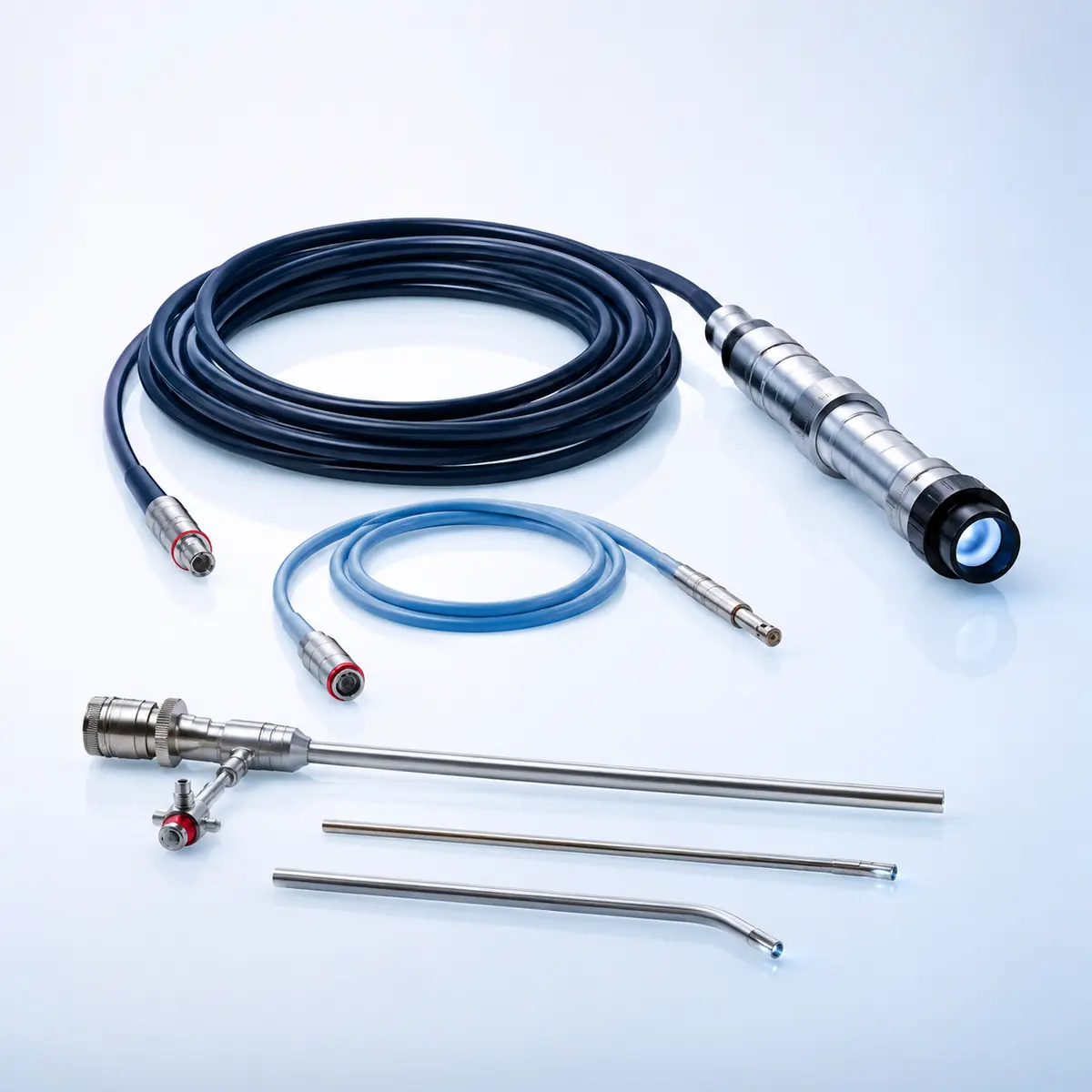
A fiber optic light cable, also called a fibre-optic light guide or light-source cable, carries illumination from a compatible external light source to a compatible endoscope or telescope. The cable normally contains an optical-fibre bundle protected by a flexible outer construction and terminated with fittings or adapters at both ends. The exact optical and mechanical design varies by product.

The cable does not transmit the camera image and is not an electrical energy cable. It should not be grouped with endoscopy video cables, camera-head cables, bipolar or monopolar electrosurgical cables, patient-plate cables, insufflator tubing or mains power leads. The term cold light describes the illumination system; it must not be interpreted as proof that cable ends cannot become hot. Product-specific instructions and facility controls remain essential.

CATEGORY BOUNDARY NOTICE

Keep this page limited to passive fiber optic illumination cables connecting a compatible medical light source to a compatible endoscope or telescope. Route light-source equipment to LED Light Source or Endoscopes & Accessories as approved; route imaging and camera components to Endoscopes & Accessories; route electrosurgical leads to Bipolar Cables or the relevant energy-accessory page; route insufflation equipment to CO2 Insufflator. Do not merge these products into one generic cable category.

Specification Guide

Two-End Compatibility Matching

The purchase description should identify the complete illumination chain before confirming an order.

System Element Information Required
Medical light source Manufacturer, exact model, light technology where relevant, port label, output interface and available equipment documentation.
Source-side interface Connector or adapter type, straight or angled arrangement where controlled, locking feature, dimensions, code and clear front/side photographs.
Fiber optic cable Existing manufacturer/code, optical bundle diameter, total or usable length, sheath/armour, flexibility, strain relief, labels and condition.
Scope-side interface Connector or adapter type, fitting dimensions, locking or retention feature, code and clear front/side photographs.
Endoscope or telescope Manufacturer, exact model or code, light-post type, diameter or specialty only where relevant and available approved compatibility reference.
Approved imaging use Standard white-light or other specifically required mode; fluorescence, NIR/ICG, blue-light or specialty imaging suitability only when exact evidence supports it.
Procurement Checklist

Fiber Optic Light Cable RFQ Checklist

Submit one line for each cable configuration to ensure accurate B2B technical pairing.

RFQ Field Information to Provide
Requirement type New cable, replacement, compatibility match, custom length or diameter, approved adapter, sample match or complete illumination-set enquiry.
Light-source details Manufacturer, exact model, port label, current adapter, light technology where relevant, equipment nameplate and manual reference.
Endoscope details Endoscope or telescope manufacturer, exact model/code, specialty, light-post or adapter and current approved cable reference.
Source-end fitting Face and side photographs, fitting type, locking or retention, dimensions, straight/angled form and code.
Scope-end fitting Face and side photographs, fitting type, locking or retention, dimensions, straight/angled form and code.
Cable dimensions Required optical bundle or cable diameter, total or usable length, tolerances where controlled and equipment-layout reason.
Construction Optical-fibre type where specified, sheath, armour or protective construction, flexibility, strain relief, colour and identification.
Optical and heat needs Agreed transmission, intensity, colour or heat-resistance requirement only when defined by approved equipment or procurement documentation.
Supplied condition Reusable or other status, sterile or non-sterile expectation, packaging and available handling or reprocessing information.
Quantity Quantity per connector/diameter/length combination, departmental allocation, spares, repeat schedule and forecast volume.
Inspection and documents Identity, dimensions, connector fit, physical condition, agreed transmission or illumination check, ISO, origin, warranty, regulatory and tender documents.
Commercial and logistics Buyer type, destination, required date, MOQ, sample, packing, taxes, freight, payment, credit and export requirements.
Comparison Guidelines

How Buyers Should Compare Light Cable Quotations

Ensure technical equivalency by analyzing specific configurations, accessories, and boundaries rather than generic system names.

Exact Matching

Match the exact light source and exact endoscope or telescope; do not compare only by a brand name or one connector.

Fitting Profiles

Verify the source-end and scope-end fittings, adapters, locking features, dimensions, orientation and approved equipment references.

Cable Integrity

Confirm optical bundle or cable diameter, total or usable length, sheath or armour, flexibility, strain relief and identification.

High-Intensity Safety

Ask for the approved light-source technology, intensity, heat and specialty-imaging limitations where these affect the requirement.

Reprocessing Limits

Confirm reusable or other status, supplied condition, packaging and available product-specific handling and reprocessing information.

Physical Condition Check

Inspect the complete cable for broken-fibre indicators, discolouration, burns, loose fittings, damaged sheath, crushing or sharp kinks before acceptance.

Written Verifications

Require written compatibility and quoted specifications; do not rely on a marketplace title, adapter resemblance or an unsupported universal claim.

Process Workflow

From Requirement to Approved Supply

Our process coordinates technical specs, two-end adapter configurations, and bulk supply logistics before delivery.

01

Send Models

Send the light-source and endoscope/telescope models, both cable-end interfaces, existing cable code, diameter, length, quantity, destination and document requirements.

02

Send Photos

Attach clear photographs of the complete cable, connector faces and sides, adapters, labels, light-source port, scope light post and equipment nameplates.

03

Technical Review

Bharat Surgical reviews the current catalogue, manufacturing or sourcing route, proposed compatibility, specification gaps, sample need, MOQ and lead time.

04

Written Quote

Bharat Surgical issues a written quotation stating accepted specifications, compatibility basis, inclusions, exclusions, price, taxes, payment, packing, delivery, warranty and validity.

05

Dispatch Controls

After order acceptance, the agreed manufacturing or procurement, inspection, identification, packing, dispatch and documentation process is followed.

06

Hospital Verification

Qualified hospital personnel complete receiving, identity, condition, compatibility, illumination and other checks required before release for clinical use.

Audience Routes

Support for Different Buyers

We support different procurement pathways depending on the institutional or commercial profile of the buyer.

Hospitals & Endoscopy Units

Hospitals may submit replacement, departmental, BOQ, tender, rate-contract or annual requirements. Include the light-source fleet, endoscope and telescope list, approved cable combinations, quantities, spare policy, reprocessing, inspection, vendor-registration, packing and document requirements.

Biomedical & CSSD Teams

Biomedical and sterile-services teams should provide equipment nameplates, connector images, existing cable codes and the facility's compatibility, inspection and reprocessing requirements. Bharat Surgical can clarify the proposed item; the qualified facility remains responsible for approval.

Surgeons & Clinical Users

Identify the approved endoscopy system and clinical illumination need already used by the facility. User observations about brightness or handling can support the enquiry, while system compatibility, optical performance, heat control, reprocessing and release should be managed through the hospital's controlled process.

Dealers, Distributors & Exporters

Submit the target market, common light-source and endoscope combinations, connector configurations, forecast quantity, replacement demand and document needs. A purchase does not grant authorization, exclusivity, territory, credit, service-partner status or brand-use rights; these require separate written terms.

Order-Specific Quality & Reprocessing Status

Inspection must be agreed for the exact cable. Depending on the accepted specification, it may include identity, length and diameter, connector dimensions and fit, cable and strain-relief condition, exterior damage, labels, optical-face condition, agreed light-transmission or illumination checks and packing verification. Do not claim an accredited laboratory, quantified transmission performance or a universal test programme unless current evidence supports it.

Heat Safety and Optical Balance

High-intensity illumination systems can produce heat at cable ends, adapters or connected instruments. The quotation should identify the approved system and any available heat or source limitations. Product selection, connection, operating checks, cooling, shutdown, reprocessing and clinical use must follow the applicable equipment instructions and facility procedure. The website must not describe the cable as cool-touch, heat-free or safe with every light source.

FAQs

Frequently Asked Questions

Find immediate answers to technical, commercial, and compatibility questions regarding Fiber Optic Light Cables.

It is a light-guide cable that carries illumination from a compatible external medical light source to a compatible endoscope or telescope. The cable, both fittings, adapters and complete equipment combination define the required item.

Yes. Buyers may use fiber optic cable, fibre-optic light guide, light cable or light-source cable for this category. The order should still identify the exact application and both equipment interfaces.

Bharat Surgical accepts enquiries for selected light-source cables. The current public category does not provide verified models, so active configurations and specifications must be confirmed before ordering.

Bharat Surgical's verified profiles describe the Mumbai company as a manufacturer and supplier of surgical instruments. Status can vary by cable, so the quotation should identify the exact item as manufactured, supplied, customized or enquiry-only.

Bharat Surgical is based in Malad West, Mumbai, Maharashtra, India. Supply, export and service feasibility depend on the cable, quantity, destination and accepted terms.

The verified company profile states that Bharat Surgical was established in 1975. Use the establishment year rather than an automatically changing experience claim.

No cable should be described or purchased as universal without exact evidence defining the light source, endoscope, both interfaces, adapters and performance limits. Similar fittings can still differ.

Identify the exact light source and endoscope or telescope, then match both cable ends, adapters, current code, diameter, length and approved compatibility reference. Send clear photographs for review.

Provide the manufacturer, exact model, port label, current adapter, light technology where relevant, equipment nameplate, existing cable reference and available manual or approved compatibility information.

Provide the manufacturer, exact model or code, light-post or adapter type, specialty where relevant and clear photographs. A procedure name alone is insufficient.

Front and side photographs help identify fitting profile, diameter, thread, locking or retention, orientation, adapter and labels. Images support identification but do not replace written compatibility confirmation.

An old code is useful, but also provide the light-source and endoscope models, both interfaces, diameter, length and photographs because codes may be incomplete, obsolete or revision-specific.

A sample-based enquiry can be reviewed. Provide the equipment combination, existing code, diameter, length, labels, both fittings, previous invoice and photographs. A physical sample may be requested.

The active source-end and scope-end combinations must be confirmed from Bharat Surgical's approved current range. Do not publish or order by a connector nickname alone.

Submit the exact light-source and endoscope manufacturers and models, both interfaces and existing cable reference. Bharat Surgical will confirm current availability; the page does not imply affiliation or blanket compatibility.

Available standard or custom lengths must be confirmed from the current range and component supply. State the required total or usable length and the equipment layout behind it.

Available optical-bundle or cable diameters must be confirmed for each connector and equipment combination. State how the diameter is defined and any approved equipment requirement.

Not as a universal rule for purchasing. Illumination depends on the complete source, cable, fittings, optical condition and endoscope. Use approved system data rather than diameter alone.

Only when the exact cable, source models, fittings, heat limits and approved compatibility support both. Do not infer this from connector fit alone.

Specialty-imaging suitability is product- and system-specific. Request exact evidence for the cable and complete imaging system; standard white-light compatibility does not establish fluorescence performance.

Do not assume inclusion. The quotation should list the source-side and scope-side adapters or fittings as included, optional, buyer-supplied or excluded, with their codes.

A custom requirement may be evaluated when the complete equipment, connector, diameter, optical, heat, reprocessing and quantity specification is available. Feasibility, approval, MOQ, price and delivery must be confirmed first.

No. A light cable carries illumination; a camera-head or video cable carries imaging signals or connects camera components. Keep them as separate procurement categories.

No. A bipolar cable connects a compatible electrosurgical instrument to a generator. A fiber optic light cable connects a light source to an endoscope or telescope for illumination.

Do not assume one status for the category. Confirm reusable or other status, construction, supplied condition, packaging and available handling or reprocessing information for the exact cable.

Do not assume sterility. The quotation, label and product information should state whether the exact cable is sterile or non-sterile and how it is packed and handled.

Autoclave compatibility is product-specific. Request the applicable instructions and have the facility verify the complete cable, fittings, adapters, sheath, adhesives, strain relief and labels against its validated process.

Request the available product-specific handling and reprocessing information with the quotation. The website should not publish one universal cycle for every light cable.

Qualified personnel should follow product and facility procedures for identity, both fittings, adapters, dimensions, physical condition, optical faces, compatibility, illumination and agreed documentation before release.

Segregate a cable with cuts, crushing, sharp kinks, loose fittings, damaged strain relief, discolouration, burns, damaged optical faces, visible broken-fibre patterns, contamination, low illumination or doubtful compatibility.

Possible causes include source settings or condition, dirty or damaged optical surfaces, incompatible fittings, fibre damage, cable diameter, adapters or endoscope condition. Qualified personnel should assess the complete chain.

Do not alter the cable or use an unverified adapter. Any modification must be evaluated by an authorized and qualified party against the exact system, performance, heat, reprocessing and safety requirements.

Do not assume repairability. Selected cables may be assessed, but accepted brands, damage limits, parts, inspection, performance checks, charges, turnaround and warranty must be confirmed after evaluation.

State the exact measurement, method, acceptance limit and report required. Availability depends on the quoted cable and agreed inspection capability; do not infer a universal certificate.

List every product-specific document required. Availability and scope must be verified for the exact cable; ISO certification or a generic company profile does not prove those product claims.

Publish only the current verified ISO standard, certificate number, certified entity, scope, certification body and validity. Replace all placeholders and do not rely on an obsolete certificate reference.

Hospitals may submit BOQs, tenders, rate contracts and replacement schedules. List each equipment and cable combination, quantity, specification, inspection, document and delivery requirement separately.

Dealer and distributor applications may be reviewed. A purchase does not grant authorization, exclusivity, territory, credit, service rights or brand-use rights without separate written terms.

International buyers may enquire with the destination, importer details, equipment references, both interfaces, diameter, length, quantity and documents. Market access and shipping responsibilities must be confirmed.

MOQ depends on the configuration, fittings, diameter, length, standard or custom route, quantity and packaging. The quotation should state the applicable MOQ.

Lead time depends on compatibility confirmation, availability, fittings, diameter, length, quantity, customization, sample approval, documents, payment and destination. The accepted quotation controls the schedule.

Warranty scope and duration are cable- and order-specific. Ask the quotation to state covered defects, exclusions, inspection requirements, claim process, freight responsibility and remedy.

Send the light-source make/model/port, endoscope or telescope make/model/light post, both cable-end photos, adapters, current code, diameter, length, quantity, destination, required date and documents.

Send Both Cable Ends and Equipment Models

Share the medical light-source manufacturer, exact model and port; endoscope or telescope manufacturer, model and light post; clear front and side photographs of both cable ends and adapters; existing cable code and labels; required diameter, length, quantity, destination, delivery date, reprocessing requirement and documentation needs. Attach a BOQ, tender schedule, previous invoice, equipment reference or approved sample details for a faster technical response.

Request Light Cable Quote Upload Cable & Equipment Photos
Supporting Links: Endoscopes & AccessoriesLED Light SourceBipolar CablesLaparoscopic InstrumentsBulk Order / B2B EnquiryContact Us