Bharat Surgical offers reusable bipolar forceps for tissue grasping, dissection and controlled bipolar coagulation in laparoscopic, open, ENT, microsurgical and other procedure-specific applications. Different tip profiles, working lengths, handle designs, connector types and irrigating or non-irrigating configurations can be supplied according to the selected model. Hospitals, surgeons, medical colleges, surgical instrument dealers, distributors and bulk buyers can contact Bharat Surgical for model selection, generator-compatibility confirmation and quotation support.
Bipolar forceps are electrosurgical instruments with two electrically active poles located at the forceps tips or jaws. Current passes between these two poles through the tissue held between them.
Unlike a monopolar instrument, a standard bipolar circuit does not require current to travel from the active instrument through a large area of the patient to a separate return electrode. However, safe operation still requires:
Bipolar forceps should not be connected to monopolar output unless the specific system instructions explicitly permit that configuration.
Laparoscopic Bipolar Forceps: Laparoscopic bipolar forceps use a long shaft for minimally invasive access. Depending on the jaw pattern, they may combine tissue grasping, dissection and bipolar coagulation.
Straight Bipolar Forceps: Straight bipolar forceps offer a direct tip-to-handle alignment and are used in various open and precision surgical procedures.
Bayonet Bipolar Forceps: Bayonet forceps have an offset profile intended to help keep the surgeon’s hand away from the direct line of sight in a deep or narrow operative field.
Angled Bipolar Forceps: Angled tips can assist access to tissue that is difficult to approach with a straight forceps pattern.
Curved Bipolar Forceps: Curved bipolar forceps may be selected for specific anatomical access and tissue presentation requirements.
Micro Bipolar Forceps: Micro bipolar forceps have fine tips for precision work in microsurgical fields. Their dimensions, tip material and intended speciality must be confirmed before purchase.
ENT Bipolar Forceps: ENT bipolar forceps are available in speciality-specific profiles for suitable ear, nose, throat and related procedures.
Irrigating Bipolar Forceps: Irrigating bipolar forceps incorporate a fluid pathway or irrigation connection. They require additional compatibility checks involving the forceps, cable, tubing and irrigation system.
Non-Irrigating Bipolar Forceps: These forceps provide standard bipolar operation without an integrated irrigation pathway.
Non-Stick Bipolar Forceps: Selected models use specialised tip materials or surface technologies intended to reduce tissue adhesion. “Non-stick” must only be claimed when supported by the exact model specification.
Bipolar laparoscopic instruments may be available with different jaw profiles.
Maryland-Pattern Jaw: A curved, tapered jaw used for precision grasping and dissection. Coagulation capability depends on the bipolar design of the selected model.
Fenestrated Grasping Jaw: A broader, windowed jaw pattern intended for tissue grasping and manipulation while providing a bipolar contact surface.
Kelly-Pattern Jaw: A dissecting and grasping profile available in selected bipolar instrument systems.
Atraumatic Grasping Jaw: Designed for comparatively gentle tissue handling while permitting bipolar energy delivery through designated contact surfaces.
Fine Dissecting Jaw: A narrow jaw profile for controlled dissection and targeted bipolar coagulation.
Blunt Jaw: A rounded or blunt configuration for suitable tissue manipulation and coagulation tasks.
The instrument should be selected by its complete jaw pattern, tip width, shaft diameter and approved intended use—not merely by the term “bipolar forceps.”
Features vary by model and may include:
Only features confirmed for the selected Bharat Surgical model should be shown in the final product specification.
| Specification | Available selection |
|---|---|
| Product | Bipolar forceps |
| Instrument category | Laparoscopic, open, ENT, microsurgical or speciality-specific |
| Function | Grasping, dissection and/or bipolar coagulation |
| Configuration | Straight, angled, curved or bayonet |
| Jaw pattern | Maryland, fenestrated, Kelly, fine, blunt or specified pattern |
| Tip width | According to selected model |
| Shaft diameter | According to selected laparoscopic model |
| Working length | Standard, extended or speciality-specific |
| Jaw action | Single action or double action, depending on model |
| Shaft rotation | Rotating or fixed |
| Handle | U-handle, X-handle, finger-ring or other specified design |
| Ratchet | Ratcheted or non-ratcheted |
| Irrigation | Irrigating or non-irrigating |
| Construction | Reusable or single-use, according to product |
| Disassembly | One-piece, modular or take-apart |
| Connector | Generator- and cable-specific |
| Bipolar cable | Included or supplied separately, as quoted |
| Sterilisation | According to the supplied instructions |
| Packing | Individual, set or bulk packing |
Exact material, tip dimensions, insulation, rated voltage, generator compatibility and sterilisation parameters require Bharat Surgical’s approved technical data.
| Requirement | Laparoscopic bipolar forceps | Open bipolar forceps |
|---|---|---|
| Access | Through a compatible laparoscopic port | Direct open surgical access |
| Construction | Long shaft with distal jaws | Tweezer-style or procedure-specific pattern |
| Rotation | Common on selected models | Generally not required |
| Handle | Ring, U, X or specialised handle | Tweezer, bayonet or other pattern |
| Cable connection | Located on handle or shaft assembly | Located on proximal end |
| Selection priority | Port size, length and jaw pattern | Tip, length, profile and speciality |
The two instrument categories are not interchangeable.
Standard bipolar forceps and advanced bipolar vessel-sealing devices are not automatically equivalent.
Standard Bipolar Forceps: Primarily used for controlled bipolar coagulation between two tips or jaws. Some models also support grasping and dissection.
Advanced Bipolar Vessel-Sealing Instrument: Part of a validated system combining a specific generator algorithm, jaw design and controlled tissue compression. Some advanced systems may also incorporate cutting.
Bharat Surgical should not describe standard bipolar forceps as a “vessel sealer” or specify a vessel-sealing diameter unless the product has been validated and documented for that claim.
When compatible bipolar energy is activated, electrical current passes from one forceps tip or jaw, through the tissue between the poles and into the opposite tip or jaw.
The tissue response depends on several factors:
The surgeon should use the generator and instrument according to their instructions rather than relying on a universal power setting.
Depending on the forceps model, possible connector arrangements may include:
The connector should be identified using the product reference and photographs. Avoid ordering only by the description “standard bipolar plug.”
Depending on the selected model and approved intended use, bipolar forceps may be used in:
Not every bipolar forceps model is suitable for every speciality. The user must follow the product-specific indications and limitations.
Irrigating Bipolar Forceps: These instruments deliver irrigation close to the tip through an integrated pathway. The complete system may require compatible tubing, fluid control and generator connections. Buyer checks include: irrigation inlet type, tubing compatibility, flow-control method, tip design, cleaning and flushing instructions, generator and cable compatibility.
Non-Irrigating Bipolar Forceps: These provide bipolar coagulation without an internal irrigation pathway. They are generally simpler to reprocess but must still be cleaned carefully around the tips and insulation.
Reusable Bipolar Forceps: Suitable for facilities with validated cleaning, functional inspection, electrical-safety inspection and sterilisation processes.
Disposable Bipolar Forceps: Supplied for single-patient use according to their labelling. They must not be cleaned, resterilised or reused unless the manufacturer’s approved instructions expressly permit it.
Reposable or Hybrid Instruments: Some systems combine reusable handles with replaceable or single-use components. Buyers must confirm which parts are reusable and which must be discarded.
Select the Surgical Approach: Specify laparoscopic, open, ENT, neurosurgical, microsurgical or another procedure type.
Choose the Tip or Jaw Pattern: Tip geometry determines access, tissue contact and grasping behaviour.
Confirm Tip Width: Fine tips support precision work, while broader tips provide a larger tissue-contact area.
Select Working Length: Longer instruments may be required for deep access, laparoscopy or bariatric procedures.
Confirm Shaft Diameter: For laparoscopic instruments, match the shaft to the intended trocar or access port.
Choose Irrigating or Non-Irrigating: Irrigating forceps require additional fluid-pathway and reprocessing considerations.
Confirm Handle Type: Choose the required tweezer, bayonet, U-handle, X-handle, finger-ring or other configuration.
Confirm Generator Compatibility: Provide the generator make, model and bipolar socket details.
Confirm Cable Compatibility: Check both generator-side and forceps-side connectors.
Review Reprocessing Requirements: Ensure the hospital can clean, inspect, test and sterilise the selected reusable model.
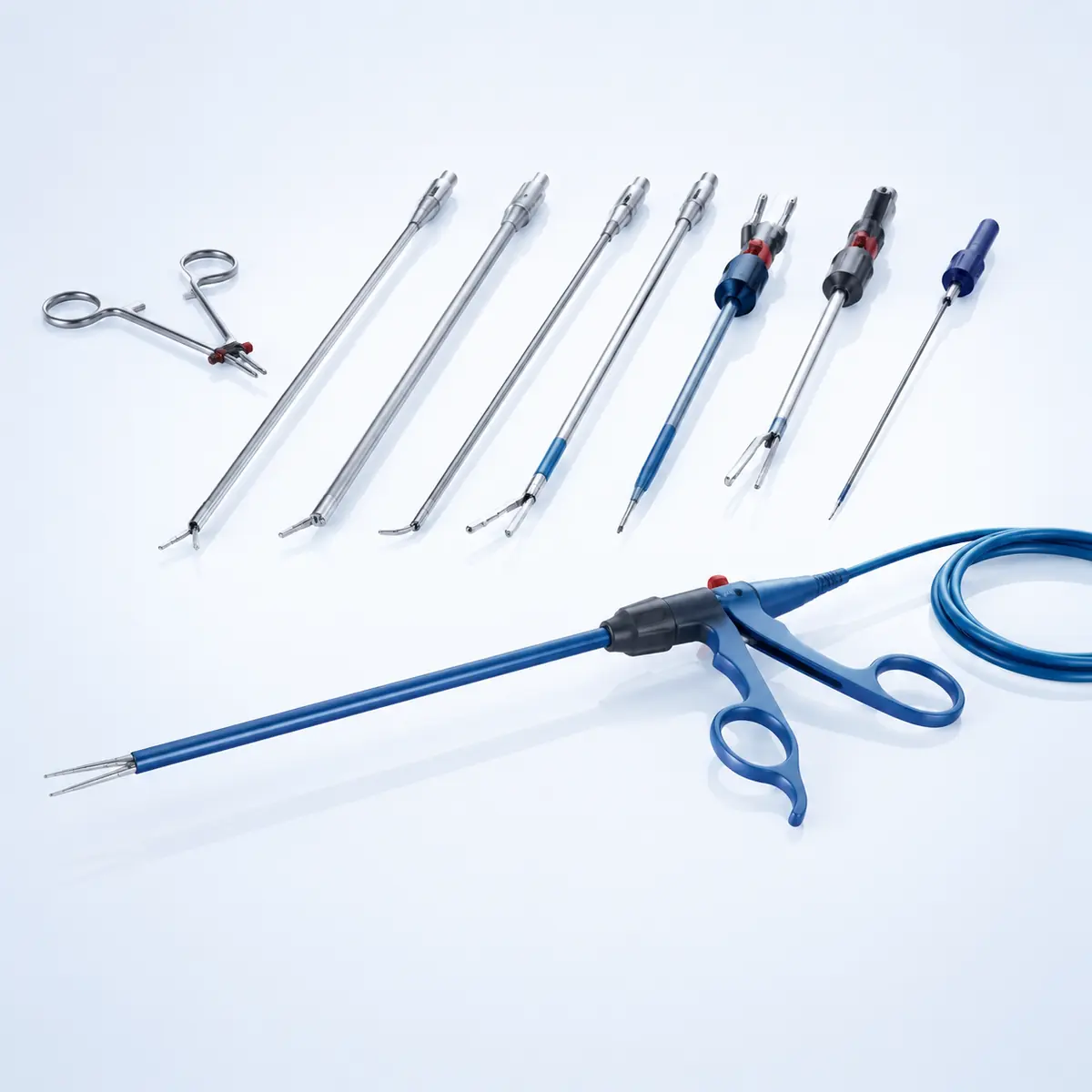
Reusable bipolar forceps must be reprocessed according to the exact manufacturer’s instructions and the healthcare facility’s validated protocol. General precautions include:
Do not publish a universal sterilisation temperature or exposure time without the approved Bharat Surgical instructions.
Avoid:
Inspect the bipolar forceps and cable before each procedure for:
Bharat Surgical supports requirements from:
Availability, certification, warranty, documentation, packing and delivery time depend on the selected instrument.
All compatibility and performance claims must appear in the final approved technical specification.
Please provide:
A reference photograph of the existing forceps and both cable connectors can help prevent compatibility errors.
Technical, generator-matching, ordering and reprocessing answers for the Bharat Surgical Bipolar Forceps range.
Bipolar forceps are electrosurgical instruments with two poles at their tips or jaws. Current passes through the tissue positioned between those poles.
Depending on the model, they may be used for grasping, dissection and controlled bipolar coagulation.
Bipolar current passes between two poles on the instrument. Monopolar current travels from an active electrode through the patient to a separate return electrode.
A conventional bipolar circuit generally does not require a separate patient return electrode. The generator’s instructions and complete procedure setup must still be followed.
No. Generator mode, output connector, voltage and cable compatibility must be confirmed.
No. Instrument-side and generator-side connectors differ between manufacturers and models.
It is a model with tip material or surface technology intended to reduce tissue adhesion. The claim must be supported by the exact product documentation.
It has an integrated fluid pathway that delivers irrigation near the forceps tip.
Reusable and disposable models are available. Reusable instruments require validated cleaning, inspection and sterilisation.
Rotating models are available in selected instrument systems. Confirm the feature for the required model.
Fine-tip straight, angled or bayonet forceps may be considered, but the exact pattern and tip width must be selected for the speciality.
Standard bipolar forceps should not be described as advanced vessel-sealing instruments unless validated documentation supports that specific claim.
Some advanced bipolar instruments incorporate cutting, but standard bipolar forceps usually should not be assumed to have a cutting function.
Selection depends on the tissue, surgical field, required precision and speciality. Share the required pattern and tip width in the enquiry.
Use only the cleaning and sterilisation process validated for the exact instrument model.
Inspect tip alignment, insulation, cable, connector, cleanliness, articulation and generator compatibility.
Possible factors include contaminated tips, excessive activation, inappropriate power, tissue condition or damaged tip surfaces. Follow the instrument and generator instructions.
Compatible bipolar cables may be supplied when the forceps connector and generator model are confirmed.
Yes. Send clear photographs, connector details, tip dimensions, instrument markings and generator information for identification.
Hospitals, dealers, distributors and export buyers can request bulk quotations for confirmed configurations.
Medical and Procurement Disclaimer: Official product portfolios confirm that bipolar forceps are available across laparoscopic, open, reusable, disposable, irrigating and non-irrigating configurations, with differences in tips, connectors and speciality use. Aesculap bipolar forceps, KARL STORZ laparoscopic bipolar forceps. Next Level 4 page: Bessinger Bipolar.
Looking for a bipolar forceps manufacturer, supplier or exporter in India? Share the required forceps type, tip pattern, working length, generator model, connector details and quantity with Bharat Surgical. Our team can assist with product configuration and cable-compatibility identification before quotation.