ISO 13485:2016 Certified
40+ Years of Excellence
600+ Products
Download Catalog
BUYER GUIDE | LAPAROSCOPIC ACCESS INSTRUMENTS

What Is a Laparoscopic Trocar?

A laparoscopic trocar is an access instrument used by a qualified surgeon to create or maintain a port through which a laparoscope or other compatible instrument can enter the required surgical space during minimally invasive surgery.

This guide answers core procurement questions regarding trocar cannula design, terminology differences, sizes, types, and reusable vs. disposable options. Final product selection must be based on the planned procedure, instrument diameter, required working length, surgeon preference, hospital protocol and applicable product instructions.

ISO 13485:2016 Certified
CE Certified Scope
Reusable Quality
Gynecology Instruments surgical instrument on a clean clinical blue background
Simple Answer

What is a Laparoscopic Trocar?

A laparoscopic trocar is an access instrument used by a qualified surgeon to create or maintain a port through which a laparoscope or other compatible instrument can enter the required surgical space during minimally invasive surgery.

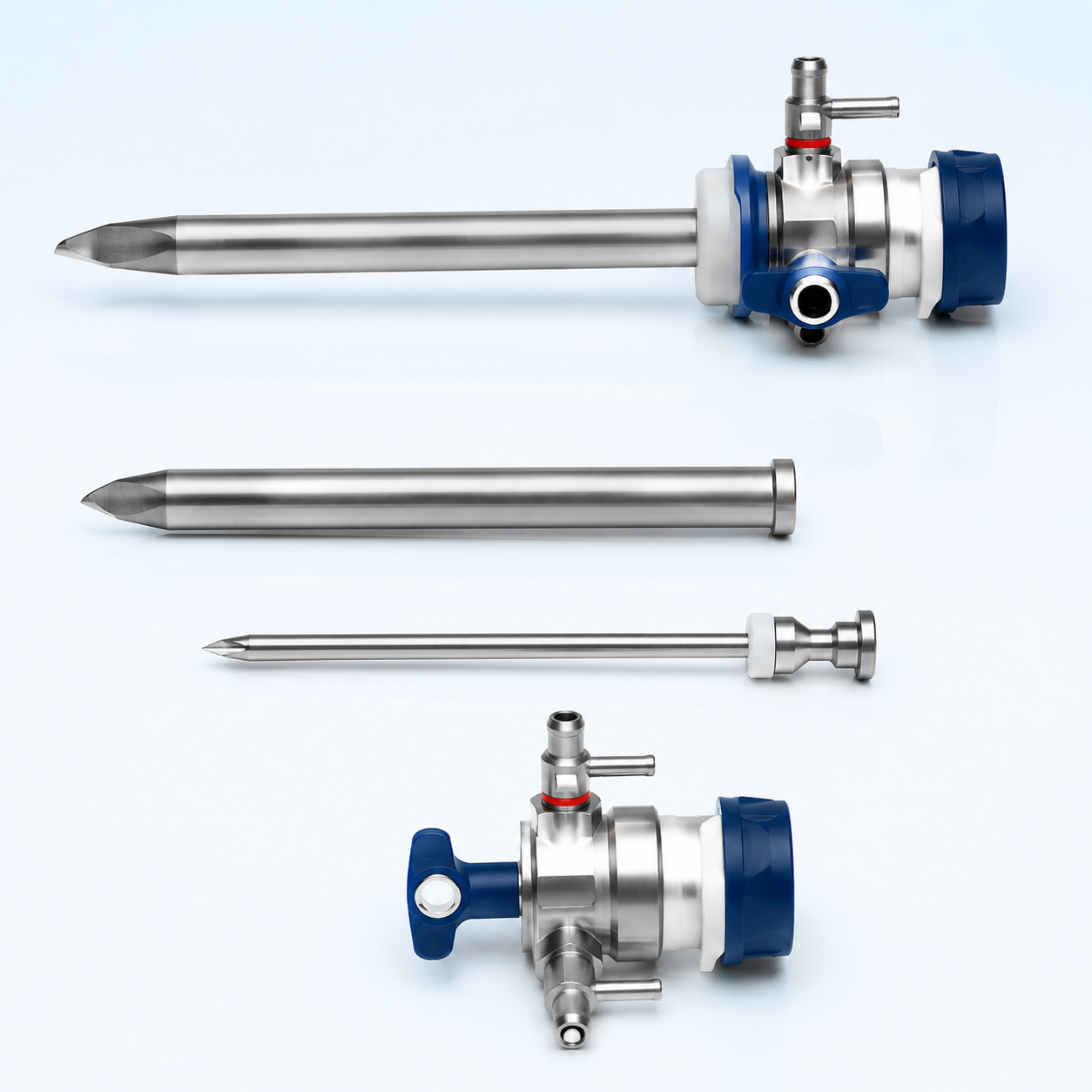
The term “trocar” is also commonly used for the complete trocar-cannula assembly. Depending on its design, the assembly may include an obturator, cannula, valve, seal, insufflation connection and reducer.

Trocar selection must be based on the planned procedure, instrument diameter, required working length, surgeon preference, hospital protocol and applicable product instructions.

Main Parts of a Laparoscopic Trocar

  • Obturator: The component inserted through the cannula during access. It may have a sharp, pyramidal, conical, blunt, bladeless, shielded or other design depending on the specific trocar system.
  • Cannula: The hollow sleeve that provides a passage for a compatible laparoscope or laparoscopic instrument after the obturator is removed.
  • Valve and Seal: The valve and seal help manage gas leakage when compatible instruments are introduced or removed. The design differs between trocar systems.
  • Insufflation Port or Stopcock: Some trocar cannulas include a connection for compatible insufflation tubing. The exact arrangement should be checked for the selected product.
  • Trocar Reducer: A reducer may allow a smaller-diameter compatible instrument to pass through a larger trocar cannula while helping manage gas leakage.
  • Fixation Features: Some cannulas have threads, ridges, sleeves or other fixation features. Buyers should confirm the required design rather than assuming that every trocar is identical.
Terminology Clarification

Trocar, Obturator and Cannula: What Is the Difference?

These terms are often used interchangeably in product enquiries, but they do not always mean the same component.

Term Meaning
Trocar May refer to the penetrating component or, commercially, the complete access assembly.
Obturator The removable component inserted through the cannula during access.
Cannula The hollow sleeve that remains as an instrument port.
Trocar assembly The combined obturator, cannula, valve, seal and applicable accessories.
Reducer An adapter used for a smaller compatible instrument within a larger port.

When requesting a quotation, specify whether you need:
Only the obturator • Only the cannula • A trocar and cannula • A complete trocar assembly • A reducer • Replacement valves or seals, where available.
This prevents confusion and incomplete quotations.

Clinical Scope

What Is a Laparoscopic Trocar Used For?

A laparoscopic trocar assembly provides an access route for compatible equipment such as:

  • Laparoscopes
  • Graspers
  • Dissectors
  • Scissors
  • Needle holders
  • Clip applicators
  • Suction-irrigation instruments
  • Retractors
  • Electrosurgical instruments
  • Other compatible laparoscopic products

The FDA describes trocar systems as devices intended to establish a path of entry for endoscopic instruments during minimally invasive procedures. (FDA trocar device summary)

The number, position, diameter and type of access ports are clinical decisions that must be made by the authorised surgeon.

Common Types of Trocars

  • Standard or Regular Trocar: A regular trocar generally uses a conventional obturator and cannula configuration. The exact tip, valve and fixation design varies between products.
  • Safety Trocar: A safety trocar may include a shielded or retracting mechanism intended to change the exposure of the penetrating tip according to its design. The term “safety trocar” should not be interpreted as risk-free. Correct product selection, training, inspection and clinical technique remain essential.
  • Bladed Trocar: A bladed trocar contains a cutting element as part of its access design. The exact blade configuration differs by product.
  • Bladeless Trocar: A bladeless trocar uses a non-bladed tip design, which may be conical, dilating or another manufacturer-defined profile. “Bladeless” does not automatically mean “atraumatic” or risk-free.
  • Blunt Trocar: A blunt trocar has a non-sharp tip configuration and may be selected for particular surgeon-approved access requirements.
  • Optical Trocar: An optical trocar is designed for use with a compatible optical system according to its intended configuration. Buyers must confirm telescope diameter and system compatibility.
  • Hasson-Type Trocar: A Hasson-type trocar or cannula is associated with an open-access configuration. The required size, sleeve, fixation and accessory details should be confirmed.
  • Balloon Trocar: Some trocar systems use an inflatable or other retention feature. Availability and configuration vary by manufacturer.
Dimensions & Selection

Common Trocar Sizes & Lengths

Trocar size usually refers to the approximate internal access diameter of the cannula or the compatible instrument diameter.

Common Market Requirements:

  • 3 mm or 3.5 mm
  • 5 mm
  • 10 mm
  • 11 mm
  • 12 mm
  • 15 mm

These are examples rather than a universal size list.

A buyer should confirm:

Cannula internal diameter • Cannula external diameter • Compatible instrument diameter • Working length • Valve and seal range • Reducer requirement • Telescope compatibility

A product labelled “5 mm” may still differ from another 5 mm product in its external diameter, working length, seal, valve or connection.

How Is Trocar Size Selected?

The authorised surgeon and hospital team should consider:

  • Intended procedure
  • Instrument diameter
  • Laparoscope diameter
  • Extraction or access requirement
  • Required working length
  • Patient and clinical considerations
  • Surgeon preference
  • Hospital protocol
  • Reducer availability
  • Existing instrument inventory
  • Reprocessing capability
  • Product instructions

A supplier should not select the trocar size solely from a general procedure name.

Trocar Length

Trocar cannulas are available in different working lengths. The appropriate length depends on the surgeon-approved requirement and compatible instrument system.

When ordering, do not write only “long trocar” or “short trocar.” Provide the required length in millimetres and clarify whether it refers to:

  • Total length
  • Cannula working length
  • Obturator length
  • Usable instrument length

This avoids measurement misunderstandings.

Comparative Economics & Policy

Reusable vs Disposable Laparoscopic Trocars

A side-by-side comparison of initial, operational, and maintenance factors.

Selection Point Reusable Trocar Disposable Trocar
Intended use Designed and labelled for repeated use after applicable reprocessing Designed and labelled for single use or single-patient use
Initial cost Often higher per unit Usually purchased per procedure or pack
Reprocessing Requires product-specific cleaning, inspection and sterilization Should not be assumed suitable for reuse
Inspection Valves, seals, tips, cannulas and moving components require inspection Packaging and product integrity require checking before use
Maintenance Components may require service or replacement where supported Generally not maintained for repeated use
Waste Reused across its approved service life Generates a discarded device after intended use
Procurement decision Depends on utilisation and reprocessing capacity Depends on procedure volume, supply and disposal policy

The appropriate option depends on clinical requirements, hospital policy, lifecycle cost and reprocessing capacity. (Internal link: Reusable vs Disposable Laparoscopic Instruments)

Is a Reusable Trocar Supplied Sterile?

Do not assume that every reusable trocar is supplied sterile. The buyer must confirm:

  • Sterile or non-sterile supply condition
  • Packaging condition • First-use preparation
  • Cleaning • Sterilization instructions
  • Assembly • Storage requirements

A reusable instrument supplied non-sterile must be processed according to the applicable instructions and healthcare-facility protocol before use.

What Is a Trocar Reducer?

A trocar reducer is an adapter used when a smaller compatible laparoscopic instrument must pass through a larger cannula.

For example, a hospital may require a reducer when using a smaller-diameter instrument through a larger compatible port.

Before ordering, confirm:

  • Existing trocar diameter • Instrument diameter
  • Reducer design • Valve requirement
  • Trocar brand or model
  • Reusable or disposable requirement

Reducers are not automatically interchangeable across all trocar systems. (Internal link: Explore Trocar Reducers)

What Is a Safety Trocar?

A safety trocar generally includes a mechanism intended to shield, retract or otherwise change exposure of the penetrating portion according to the particular product design.

However, remember that:

  • “Safety” does not mean risk-free
  • Mechanisms differ between manufacturers
  • The device requires correct inspection
  • Users require appropriate training
  • Product instructions must be followed
  • Clinical technique remains the surgeon’s responsibility

(Internal link: Safety Trocar vs Regular Trocar)

Buyer Checklist

How to Choose a Laparoscopic Trocar

Before requesting a quotation, confirm these details:

  • Product Type: Specify regular trocar, safety trocar, bladed trocar, bladeless trocar, blunt trocar, optical trocar, Hasson-type trocar or another specified design.
  • Diameter: State the required diameter in millimetres.
  • Length: State the cannula working length or other required measurement.
  • Reusable or Disposable: Confirm the required product category.
  • Cannula Design: Specify smooth, threaded, ribbed, fixation feature or other required design.
  • Valve and Seal: Confirm valve design, seal range, replaceable component requirement or gas-leakage acceptance requirement.
  • Insufflation Connection: State whether a stopcock or other connection is required.
  • Reducer: Mention the smaller instrument diameter that must be accommodated.
  • Quantity: Specify the number of complete assemblies and any additional cannulas or reducers.
  • Documentation: State any required certification, material information, instructions or inspection documentation.

Information to Include in a Trocar Enquiry

Please send:

  • Buyer or hospital name
  • Required trocar type • Quantity
  • Diameter • Cannula working length
  • Obturator tip design
  • Reusable or disposable requirement
  • Cannula fixation design (smooth/threaded/etc.)
  • Valve configuration • Insufflation-port need
  • Reducer requirement • Compatible instrument size
  • Reference photograph • Existing product marking
  • Required documentation
  • Delivery location • Expected delivery date

* A photograph should be accompanied by dimensions because visual appearance alone may not identify the exact trocar.

Quality Control & Care

Trocar Inspection, Cleaning and Replacement

Important workflows and inspection checks for healthcare facilities using reusable access systems.

Trocar Inspection Before Use

Inspection should follow the applicable product instructions and hospital procedure. Depending on the trocar design, checks may include:

  • Cleanliness
  • Cannula straightness
  • Obturator condition • Tip condition
  • Safety mechanism function
  • Valve movement • Seal integrity
  • Stopcock function • Reducer fit
  • Assembly and locking
  • Visible corrosion • Cracks or damage
  • Compatibility with the intended instrument

A trocar with damaged, missing, incorrectly assembled or non-functional components should be removed from use and evaluated by authorised personnel.

Cleaning & Sterilization

Reusable trocars contain valves, seals, lumens, sleeves, stopcocks and detachable components. These features require careful, product-specific reprocessing.

The healthcare facility should follow instructions for:

  • Point-of-use handling • Disassembly
  • Cleaning • Brushing and flushing channels
  • Rinsing • Drying
  • Inspection • Functional testing
  • Reassembly • Packaging
  • Sterilization • Protected storage

The FDA explains that reusable medical devices undergo a detailed reprocessing process involving cleaning followed by appropriate disinfection or sterilization. (FDA reusable medical-device guidance)

Do not apply one general sterilization cycle to every trocar without confirming product compatibility.

When to Repair or Replace?

A trocar should be isolated and evaluated if there is:

  • A damaged obturator tip
  • A bent cannula
  • A non-functional safety mechanism
  • Gas leakage • A damaged valve
  • A damaged or missing seal
  • A loose stopcock
  • Difficulty assembling components
  • Visible corrosion • Cracks
  • Retained residue
  • Uncertain compatibility

Repair feasibility depends on the design, condition, available components and required post-repair performance.

Laparoscopic Trocars from Bharat Surgical
Quality Assurance System

Laparoscopic Trocars from Bharat Surgical

Bharat Surgical manufactures and supplies selected reusable laparoscopic trocars, safety trocars and trocar reducers.

ISO 13485:2016-certified medical-device quality management system
ISO Registration Number: RQMD91/11579
Scope: Manufacturing, sale and servicing of laparoscopy, urology, gynecology, micro and general surgery instruments.
Certificate expiry: 11 September 2027

Bharat Surgical also holds CE Certificate No. 9277, with a defined product scope that includes laparoscopy instruments. CE applicability and supporting documentation must be confirmed for the specific trocar being quoted. (Internal link: Explore Laparoscopic Trocars)

Got Questions?

Frequently Asked Questions

Find immediate answers to common operational questions regarding laparoscopic trocars.

A laparoscopic trocar is an access instrument used to establish or maintain a port for a compatible laparoscope or instrument during minimally invasive surgery.

A trocar assembly may include an obturator, cannula, valve, seal, insufflation connection and reducer.

Not exactly. The cannula is the hollow sleeve, while “trocar” may refer to the penetrating component or the complete commercial assembly.

Compatible laparoscopes, graspers, scissors, needle holders, clip applicators, suction-irrigation instruments and other laparoscopic products may pass through the cannula.

Common market requirements include 3 mm, 5 mm, 10 mm, 11 mm, 12 mm and 15 mm, but availability and exact dimensions vary.

A 5 mm trocar is intended to provide access for a compatible instrument or scope according to the approved surgical requirement. Its use is determined by the surgeon.

It is a trocar assembly designed around an approximately 10 mm access requirement. Exact internal and external dimensions should be checked.

A safety trocar contains a mechanism intended to shield or alter exposure of the penetrating portion according to its design. It is not risk-free.

A bladeless trocar has a non-bladed obturator design. “Bladeless” does not automatically mean atraumatic or suitable for every requirement.

An optical trocar is designed for use with a compatible optical system. Telescope and system compatibility must be confirmed.

A Hasson-type trocar or cannula is associated with an open-access configuration. Exact size and component requirements vary.

A reducer allows a smaller compatible instrument to pass through a larger trocar cannula while helping manage the port seal.

Some trocars are designed and labelled for reuse, while others are single-use. The product’s intended category must be confirmed.

Not necessarily. Confirm whether it is supplied sterile or non-sterile and follow the applicable first-use preparation instructions.

A single-use trocar should not be assumed suitable for reuse. Follow its labelling and applicable healthcare and regulatory requirements.

Selection depends on the intended procedure, compatible instrument diameter, scope, working length, surgeon preference and hospital protocol.

Replacement cannulas may be available for compatible systems. Provide the existing trocar size, model, connection and photographs.

Follow the product-specific instructions and the healthcare facility’s validated cleaning, packaging and sterilization process.

A photograph can assist identification, but dimensions, valve design, product markings and compatibility details may also be required.

Provide the type, diameter, working length, tip design, reusable or disposable requirement, valve, reducer, quantity and delivery location.

Request a Laparoscopic Trocar Quotation

Looking for reusable laparoscopic trocars, safety trocars, cannulas or reducers? Send Bharat Surgical the required diameter, working length, trocar design, quantity, photographs and delivery location.

Chat on WhatsApp