ISO 13485:2016 Certified
40+ Years of Excellence
600+ Products
Download Catalog
MANUFACTURER & SUPPLIER | B2B UROLOGY INSTRUMENTS

Visual Obturator
Manufacturer, Supplier and Exporter in India

Bharat Surgical manufactures and supplies reusable visual obturators for hospitals, urology centres, medical colleges, surgical-instrument dealers and international distributors. A visual obturator is designed to combine a compatible obturator-and-sheath assembly with a rigid telescope for direct endoscopic visualisation. Visual obturators are system-specific instruments. Sheath size, telescope diameter, working length, viewing angle and locking interface must be confirmed together before placing an order.

ISO 13485:2016 Certified
40+ Years Experience
Mumbai Warehousing
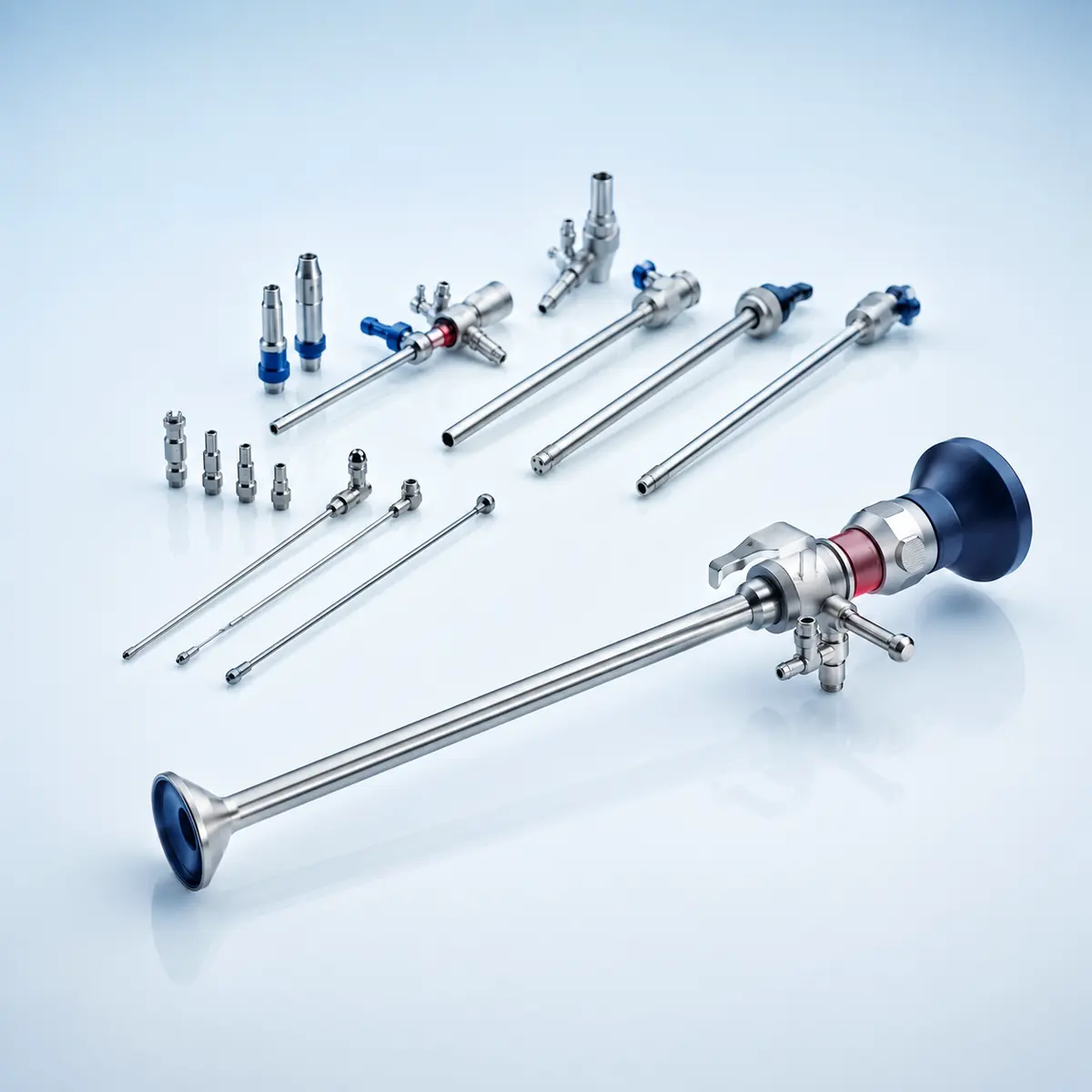
Visual Obturator surgical instrument on a clean clinical blue background
Overview

What Is a Visual Obturator?

A visual obturator is an obturator configuration that accommodates or connects with a compatible rigid telescope. Unlike a standard obturator used without an optical view, the visual configuration forms part of an endoscopic assembly that provides visualisation through the installed telescope.

A visual obturator is not a complete cystoscope, urethrotome or resectoscope system. It must be used with its specified sheath, telescope, imaging equipment and other compatible components.

Visual obturators are system-specific instruments. Sheath size, telescope diameter, working length, viewing angle and locking interface must be confirmed together before placing an order.

Brand-Type Compatibility Notice

A brand-type reference does not mean the product is manufactured by the referenced OEM, that the trademark owner has approved or endorsed the product, that the obturator fits every system from that manufacturer, or that compatibility testing or verification can be omitted. All third-party trademarks remain the property of their respective owners.

Clinical selection and use must follow the applicable instructions for use and institutional protocols.

Product Range

Bharat Surgical Visual Obturator Range

Bharat Surgical lists Visual Obturator as a dedicated Level 3 category within its urology instrument range. Its current public category page does not state an exact French size, telescope diameter, viewing angle, working length or material grade. These details must therefore be confirmed through a technical quotation. View Bharat Surgical’s published Visual Obturator category.

Available or custom-quoted configurations may include:

Visual obturator
Telescope-compatible visual obturator
Cystoscopy-system visual obturator
Resectoscope-system visual obturator
Sheath-specific visual obturator
Standard-flow system configuration
Continuous-flow system configuration
Brand-type compatible visual obturator
Visual obturator supplied with a matching sheath
Replacement visual obturator
Compatible telescope, where required

Availability depends on the system, dimensions, interface, quantity and documentation requirements.

System Details

Components of a Visual Obturator Assembly

ComponentFunction within the assemblyDetails to confirm
Visual obturatorFits the corresponding sheath and accommodates the telescopeSize, length, profile and lock
Compatible sheathHouses the obturator-and-telescope assemblyFrench size, working length and flow configuration
Rigid telescopeProvides endoscopic visualisationDiameter, length, viewing angle and light post
Telescope lockSecures the telescope in the required positionInterface and system series
Distal profileForms the distal end of the assembled systemShape, alignment and sheath match
Irrigation portsBelong to the compatible sheath configurationNumber, position and connector style
Light cableConnects the telescope to the light sourceConnector at both ends
Camera couplerConnects the telescope to the imaging systemEyepiece and camera-head compatibility

The supplied package may include only the visual obturator. Confirm the sheath, telescope, light cable and imaging accessories separately.

Visual Obturator vs Standard Obturator

Selection pointVisual obturatorStandard obturator
Telescope integrationDesigned to accommodate or connect with a compatible telescopeNormally used without a telescope through the obturator
VisualisationForms part of an optical viewing assemblyDoes not itself provide an optical view
Compatibility requirementsSheath, telescope, angle, length and lockSheath size, length, tip and lock
ConstructionIncludes a defined telescope channel or optical interfaceSolid or non-optical model-specific construction
Procurement priorityComplete system identificationExact sheath identification

The two types should not be treated as interchangeable.

Visual Obturator vs Sheath

The visual obturator and sheath are separate but matching components:

The sheath provides the external access and irrigation structure.
The visual obturator fits inside the sheath and carries or connects with the compatible telescope.
The telescope supplies the optical view.
The light cable and camera system transmit and display the image.

A visual obturator should not be described as a complete sheath unless the supplied product includes both components.

Instrument Comparisons

Visual Obturator vs VIU and Cystoscope Sheaths

Visual Obturator vs VIU Sheath

A visual obturator and a VIU or optical urethrotomy sheath are not the same instrument.

FeatureVisual obturatorVIU sheath
Product typeOptical obturator componentOptical urethrotomy sheath component
Main compatibilityMatching sheath and telescopeMatching urethrotomy system, telescope and working element
Cutting mechanismNot impliedSeparate compatible urethrotomy component may be required
InterchangeabilityNot interchangeable by defaultNot interchangeable by default

Bharat Surgical lists its VIU sheath as a separate product category and product. View the separate Bharat Surgical optical urethrotomy sheath.

Visual Obturator vs Cystoscope Sheath with Obturator

A cystoscope sheath may be supplied with a standard obturator, while a visual obturator is designed around a telescope-compatible configuration.

Bharat Surgical publishes cystoscope sheaths with obturators in sizes including 15.3 Fr, 17 Fr, 19 Fr, 20 Fr, 21 Fr, 22 Fr and 25 Fr. Those published cystoscope sizes must not automatically be treated as Bharat Surgical visual obturator sizes. Review the separate cystoscope sheath with obturator.

Sheath Compatibility

A visual obturator must correspond to the sheath’s:

Manufacturer or system series
French size
Internal diameter
Working length
Distal profile
Proximal locking mechanism
Irrigation configuration
Inner or outer sheath arrangement
Telescope position

A matching French size alone does not prove compatibility. Internal geometry, length and locking interfaces can differ between manufacturers and system generations.

Technical Engineering

Telescope Integration, Dimensions & Flow Design

Telescope Compatibility

Before ordering, confirm:

Telescope manufacturer
Exact model or catalogue number
Telescope diameter
Working length
Viewing angle
Eyepiece design
Light-post type
Distal optical position
Proximal locking interface
Camera coupler
Light cable connection

A telescope may physically enter the obturator channel yet remain incompatible because its length, viewing angle or locking position differs.

Why the Telescope Viewing Angle Matters

Rigid urology telescopes may be supplied with different viewing angles. The required angle depends on the visual obturator’s construction and approved system configuration.

For replacement enquiries, provide the angle engraved on the telescope and its catalogue number. Do not identify the required obturator using telescope diameter alone.

Working Length and Total Length

Working length describes the usable portion of the instrument within its intended assembly. Total length includes proximal connections and other external sections. Both measurements may be required when:

Replacing an existing visual obturator
Matching a telescope
Matching a sheath
Reviewing optical alignment
Comparing system generations
Preparing a custom enquiry

Measurements should be supported by a drawing or physical sample where catalogue information is unavailable.

Understanding French Size

Sheaths used with visual obturators may be described in French size, abbreviated as Fr. Approximate nominal diameter in millimetres = French size ÷ 3.

French sizeApproximate mathematical diameter
17 Fr5.7 mm
19 Fr6.3 mm
21 Fr7.0 mm
22 Fr7.3 mm
24 Fr8.0 mm
26 Fr8.7 mm

These conversions explain the French scale only. They are not Bharat Surgical visual obturator specifications or proof that a particular size is available.

Engineering & Checklist

Design Features, Materials & Compatibility Checklist

Standard-Flow vs Continuous-Flow Systems

A visual obturator may be associated with a standard or continuous-flow sheath configuration.

Standard-Flow Configuration: A standard sheath may have one defined irrigation connection according to its system design.

Continuous-Flow Configuration: A continuous-flow system may contain inner and outer sheath components, separate inflow and outflow ports, multiple stopcocks, model-specific seals, and a system-specific obturator interface. The visual obturator must match the exact inner or outer sheath arrangement. Similar-looking continuous-flow systems are not necessarily interchangeable.

Distal-Tip & Locking Mechanisms

The assembled distal profile depends on the relationship between the visual obturator, telescope and sheath. Procurement checks should include distal shape, tip length, telescope window position, telescope alignment, transition between obturator and sheath, surface finish, absence of visible irregularities, and model-specific orientation marks. The distal profile should not be modified by the buyer or user.

Visual obturators may use rotating locks, bayonet-style interfaces, snap or click mechanisms, threaded connections, model-specific couplings, or separate telescope locks. A lock that appears to engage may still position the telescope incorrectly. The assembled system should be evaluated according to the manufacturer’s instructions.

Material and Construction

Reusable visual obturators commonly contain stainless-steel components and may also incorporate seals, locking components or other materials. Bharat Surgical’s exact material grade is not stated on the current category page and should be confirmed in the quotation.

Institutional buyers should review surface finish, tube straightness, telescope-channel patency, distal alignment, locking accuracy, sheath fit, seal condition, corrosion or staining, product identification, traceability, and reprocessing compatibility. Material grade, surface-finish data and passivation documentation should be requested when required by a tender or importing authority.

Visual Obturator Compatibility Checklist

Compatibility pointInformation required
Existing systemManufacturer, system name and catalogue number
SheathFrench size, working length and flow type
TelescopeDiameter, length, viewing angle and model
Visual obturatorExisting model, length, tip and lock
Locking mechanismPhotographs of all proximal interfaces
Distal alignmentPhotographs or technical drawing
Imaging equipmentCamera coupler and light-cable details
ReprocessingValidated method in the IFU
Replacement requestExisting markings and physical sample, if required
DocumentationTender and destination-country requirements
Reprocessing & Care

Reprocessing, Autoclaving and Maintenance

Reusable Visual Obturators

Reusable visual obturators may contain a narrow telescope channel and locking surfaces that require careful cleaning, drying and inspection. The US FDA describes reusable-device reprocessing as a detailed, multistep process involving cleaning followed by appropriate disinfection or sterilisation. Read the FDA’s reusable-device reprocessing information.

Follow the current product-specific IFU.
Begin point-of-use treatment as directed.
Remove the telescope and detachable components.
Open locks, valves or removable parts where specified.
Brush and flush accessible channels using validated accessories.
Clean distal and proximal connection surfaces.
Use only compatible cleaning agents.
Rinse internal and external surfaces as instructed.
Dry the telescope channel and other recesses thoroughly.
Inspect locks, seals, channels and distal alignment.
Use only a validated sterilisation or disinfection cycle.
Store the processed instrument in a protected condition.
Maintain the facility’s reprocessing records.

Cleaning must precede sterilisation or high-level disinfection because retained contamination can interfere with the process. See the CDC disinfection and sterilisation guideline. The product-specific IFU and applicable local requirements always take priority.

Can a Visual Obturator Be Autoclaved?

Steam sterilisation should be used only when the current IFU validates it for the exact visual obturator and all detachable parts. Confirm permitted sterilisation method, required disassembly, validated cycle parameters, cleaning-agent compatibility, drying requirements, packaging and tray requirements, seal and lock compatibility, and inspection or service-life criteria. The telescope may have separate reprocessing instructions and should be processed according to its own IFU.

Pre-Use Inspection Checklist

Visual obturator is the correct model for the sheath
Telescope is the correct diameter, length and viewing angle
Telescope channel is unobstructed
Sheath and obturator engage securely
Telescope lock engages correctly
Distal components are aligned
No dents, bends or deformation are present
No burrs, cracks or sharp irregularities are visible
Seals and connectors are complete
Surface is free from visible soil, staining or corrosion
Imaging and light connections function according to the system check
Reprocessing status is complete and documented — any damaged, incomplete or mismatched component should be removed from service.
Procurement

Example Visual Obturator System BOQ

ComponentSuggested quantity
Visual obturator1
Matching sheath1
Compatible rigid telescope1
Inner or outer sheath component, where applicable1
Irrigation stopcocks and connectors1 set
Compatible light cable1
Camera coupler1
Cleaning accessories specified by the IFU1 set
Sterilisation tray or container1
Spare seals, where available1 set

This BOQ is a procurement template, not a clinical setup guide. The final assembly should be approved by qualified urology, biomedical and sterile-services personnel.

B2B Channels

Selection Guidelines & Supply Channels

Choosing the Correct Visual Obturator

Before requesting a quotation, determine:

Existing urology system
Manufacturer and catalogue number
Required sheath size
Sheath working length
Standard or continuous-flow configuration
Telescope manufacturer and model
Telescope diameter
Telescope working length
Viewing angle
Visual obturator length
Distal-tip profile
Proximal locking mechanism
Light cable and camera compatibility
Reprocessing requirements
Quantity and spares
Tender and documentation requirements

Visual Obturators for Hospitals & Medical Colleges

For Hospitals: Hospitals and urology centres may request new visual obturators, replacement visual obturators, matching sheath configurations, compatible telescope quotations, spare seals and components, sterilisation trays, biomedical compatibility review, tender BOQ assistance, and replacement planning. Existing system details should be provided before purchasing a replacement component.

For Medical Colleges: Medical colleges and teaching hospitals may request configured sets for authorised clinical use, skills training, demonstration or equipment familiarisation. The intended environment should be stated in the enquiry so the appropriate product configuration and documentation can be discussed.

Visual Obturators for Dealers and Importers

Bharat Surgical accepts enquiries from:

Urology instrument dealers
Endoscopy-equipment distributors
Hospital suppliers
Medical-device importers
Tender suppliers
Export procurement companies

Dealers may request individual components, mixed urology-instrument orders, bulk quantities, export packaging and available technical documentation. Destination-country registration, labelling and import requirements must be confirmed before supply.

Why Source Visual Obturators from Bharat Surgical?

Dedicated visual obturator product category
Replacement and configured-set enquiries
Sheath-and-telescope compatibility review
Supply for hospitals and urology centres
Dealer, distributor and importer support
Bulk and institutional procurement
Export-order assistance
Technical quotation based on system details

Exact sizes, materials, viewing-angle compatibility, supplied components, reusable status and sterile supply condition must be verified against the final quotation and product-specific documentation.

Immediate Answers

Frequently Asked Questions

Technical, compatibility, ordering and reprocessing answers for the Bharat Surgical Visual Obturator range.

A visual obturator is an obturator designed to accommodate or connect with a compatible rigid telescope as part of an endoscopic urology system.

Bharat Surgical lists Visual Obturator as a dedicated category within its urology instrument range.

The current public category page does not state exact sizes. Required size and availability must be confirmed in the quotation.

Because Bharat Surgical has not published model-wise dimensions for the visual obturator category.

No. A visual obturator integrates with a compatible telescope, while a standard obturator normally does not.

It is designed to accommodate or connect with a telescope. Whether the telescope is included depends on the quoted package.

No. Diameter, length, viewing angle and locking interface must match the visual obturator.

The telescope and visual obturator must align correctly at the distal end within the approved system configuration.

No. It is one component of a system that may also require a sheath, telescope, camera, light cable and other accessories.

No. The obturator fits within a corresponding sheath; they are separate components.

It may be quoted separately or with a matching sheath. Confirm the package contents.

No. A VIU sheath is part of a separate optical urethrotomy instrument system.

Only if the complete system documentation specifically establishes that compatibility.

Some configurations may form part of a compatible resectoscope system. The exact platform must be identified.

French size is a scale used to describe the nominal outside diameter of a sheath or tubular medical instrument.

Divide the French size by three to obtain the approximate nominal diameter in millimetres.

No. Working length, internal geometry, telescope position and locking mechanism must also match.

It is a visual obturator used with a compatible sheath assembly having defined inflow and outflow paths.

Not unless the manufacturer specifically identifies the components as compatible.

It is the usable length of the instrument within its intended sheath-and-telescope assembly.

It is the shape and alignment of the assembled instrument at its far end.

The telescope, obturator and sheath must occupy their specified positions within the complete assembly.

Reusable models commonly contain stainless-steel components, but Bharat Surgical’s exact material grade should be confirmed.

Reusable configurations may be available. Confirm reusable status and the applicable IFU.

Not necessarily. Reusable design and supplied sterile condition are separate specifications.

Only when the product-specific IFU validates steam sterilisation for that exact component.

Follow the separate IFU for each component. Their validated processing instructions may differ.

Follow the IFU for brushing, flushing, rinsing, drying and inspection using validated accessories.

Yes. Cleaning must precede the applicable validated sterilisation or disinfection process.

Check the channel, distal end, locks, seals, sheath fit and telescope alignment as specified in the IFU.

Yes, subject to establishing compatibility with the existing sheath and telescope.

A configured set may be quoted after the sheath, telescope, flow and imaging requirements are confirmed.

Matching may be reviewed using catalogue details, dimensions, photographs or a physical sample.

It describes an intended interface and does not imply OEM manufacture, endorsement or universal compatibility.

Dealers, distributors, importers and institutional suppliers may request bulk quotations.

Price depends on dimensions, sheath and telescope compatibility, locking system, included components, quantity and documentation.

Provide the system manufacturer, catalogue numbers, sheath size, telescope dimensions, viewing angle and clear interface photographs.

Medical and Procurement Disclaimer: This page provides general product and procurement information for qualified healthcare organisations and medical-device buyers. It is not a clinical or procedural instruction and does not replace professional training, clinical judgement, institutional protocols or product-specific instructions for use. Intended use, compatibility, reprocessing, sterilisation, supplied condition and regulatory status must be verified before purchase and use.

Request a Quote for a Visual Obturator

Contact Bharat Surgical with the sheath size, working length, telescope manufacturer, model, diameter, viewing angle, locking-interface details, quantity and delivery destination. For replacement enquiries, include catalogue numbers and clear photographs of the existing sheath, obturator and telescope connections.
Visual Obturator Price Factors: Sheath size, working length, telescope diameter and compatibility, viewing-angle configuration, distal-tip design, locking mechanism, standard or continuous-flow system, visual obturator only or complete set, material and construction, quantity, sterilisation tray, documentation, packaging and delivery destination.