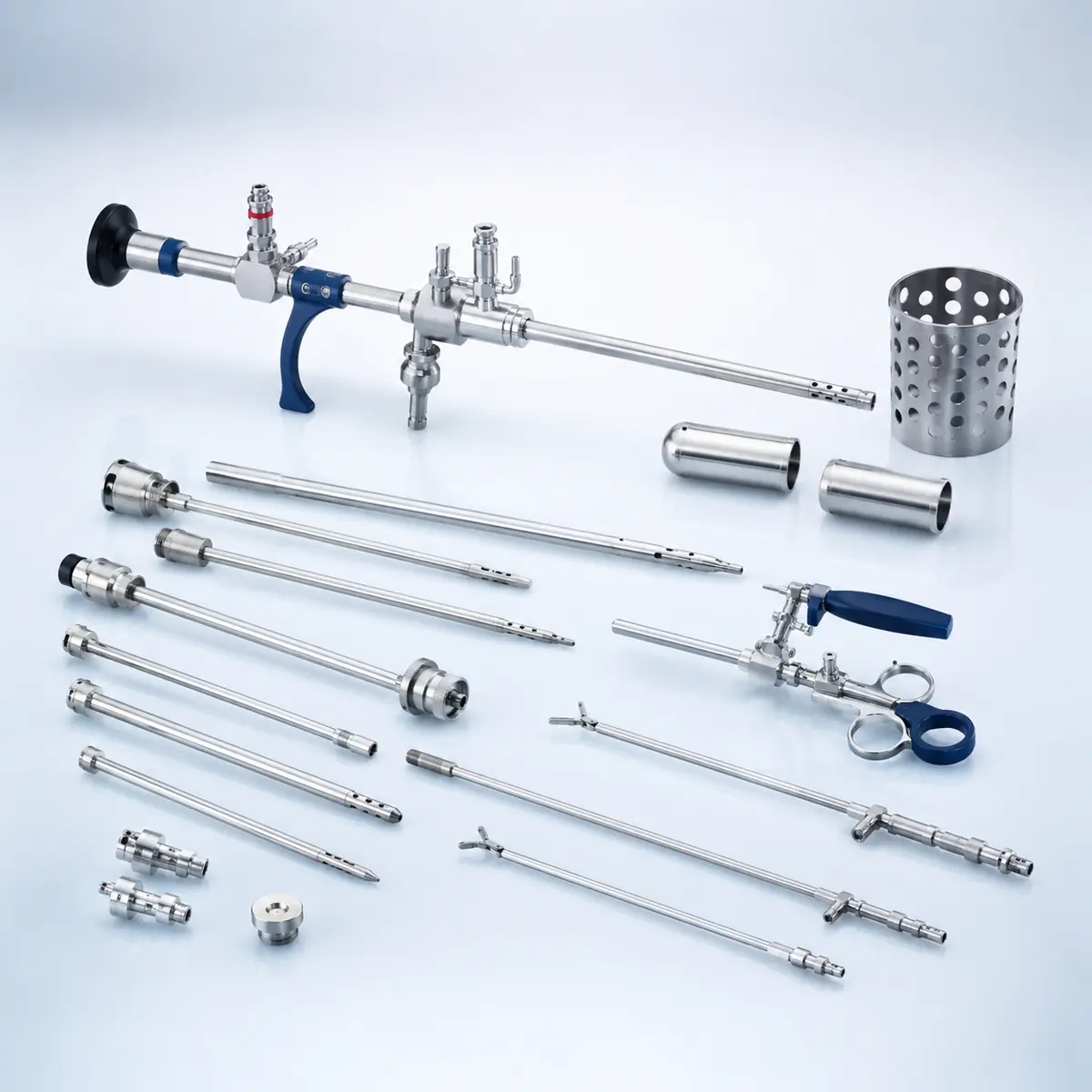
Bharat Surgical offers PCNL instruments for hospitals, urology departments, surgical centres, medical-equipment dealers and international distributors. These instruments support the visualisation, access, fragmentation and retrieval requirements associated with percutaneous nephrolithotomy and related endourology procedures. A PCNL instrument set is not a single universal configuration. The required components depend on the nephroscope, operating sheath, stone-fragmentation platform, working-channel dimensions and the surgeon’s preferred setup. Bharat Surgical therefore supplies PCNL instruments against confirmed technical requirements rather than assuming compatibility from a general description.
PCNL instruments are specialised endourology devices used as part of a percutaneous nephrolithotomy setup.
Depending on the selected system, a PCNL configuration may include visualisation instruments, sheaths, obturators, dilators, stone forceps, graspers, irrigation accessories and compatible stone-fragmentation components.
These products must be selected as an integrated system. An instrument that fits one nephroscope or sheath may not fit another system, even if both have similar-looking connectors or nominal sizes.
The exact Bharat Surgical PCNL range should be confirmed against the current catalogue and quotation. Depending on availability and the requested configuration, the range may include:
Bharat Surgical’s published range includes an Optical Stone Crushing Forcep offered in standard sizing, with SS 304 and brass listed as materials. However, its exact compatibility with a PCNL system must be confirmed before ordering. Bharat Surgical also lists a stainless-steel/brass stone punch set, although a stone punch intended primarily for bladder-stone work should not automatically be treated as a PCNL component. These products must be selected according to their approved intended use and supplied instructions. See the published Optical Stone Crushing Forcep and Stone Punch Set listings.
The nephroscope provides visual access to the operative field. Procurement teams should confirm its diameter, viewing angle, working length, working-channel dimensions, eyepiece interface, light connection and camera-system compatibility.
The operating sheath forms the passage through which compatible visualisation and working instruments are introduced. The sheath and obturator must be matched by model, size, length, profile and locking arrangement.
A PCNL access configuration may use dilators, guidewires and associated accessories. These may be reusable or supplied as sterile single-use products. The exact access system must be selected by the clinical team and verified against its instructions for use.
Graspers and forceps may be used to handle or retrieve stone fragments. Their jaw pattern, shaft length, outer diameter and working-channel compatibility should be confirmed before purchase.
PCNL systems may be used with pneumatic, ultrasonic, laser or combined lithotripsy technologies. Probes, fibres and connectors are not universally interchangeable. Compatibility must be established from the fragmentation system manufacturer’s documentation.
Irrigation supports visibility within the system, while compatible suction arrangements may assist fluid and fragment management in supported configurations. Connector type, tubing specification, permitted pressure and compatibility must be verified for the selected equipment.
| PCNL component | Details to confirm before ordering |
|---|---|
| Nephroscope | Brand, model, diameter, viewing angle, length and working channel |
| Operating sheath | French size, working length, profile and locking system |
| Obturator | Exact sheath model, tip design and size |
| Dilator system | Dilator type, size sequence, guidewire compatibility and intended use |
| Stone forceps | Shaft diameter, length, jaw pattern and working-channel requirement |
| Optical forceps | Telescope or optical system, sheath interface, length and locking arrangement |
| Lithotripsy probe | Energy platform, generator model, probe diameter and working length |
| Laser fibre | Laser-system approval, fibre diameter and compatible working channel |
| Irrigation accessory | Port design, connector type, tubing and permitted flow conditions |
| Suction accessory | Sheath or device model, connector and validated operating limits |
| Light cable | Light-source connector and scope-side connector |
| Camera head | Eyepiece interface, coupler and camera-platform compatibility |
| Instrument tray | Set contents, dimensions and sterilisation-system suitability |
Important: Terms such as “Storz type,” “compatible type” or “standard size” are not sufficient by themselves to establish interoperability. Obtain written compatibility confirmation for the exact models being connected.
Features vary by product and configuration. Buyers should refer to the final quotation, product label and supplied instructions for the confirmed specification.
A PCNL setup can contain both reusable and single-use products.
Reusable instruments may include compatible nephroscopes, operating sheaths, obturators, metal dilators, forceps and selected connectors. Reusable status must be confirmed on the product label or instructions for use.
Sterile single-use components may include selected guidewires, access needles, balloon dilators, drainage products, laser fibres or other consumables. A product marked single-use must not be treated as reusable merely because it appears physically undamaged.
Do not assume that every item in a PCNL set is supplied sterile. The sterile or non-sterile status of each component should be stated separately in the purchase order.
Before requesting a quotation, hospitals and dealers should identify:
Sheaths and access components are frequently described using French size. As a nominal conversion:
Diameter in millimetres ≈ French size ÷ 3
For example, 24 Fr corresponds nominally to approximately 8 mm. This conversion is useful for preliminary procurement comparison, but it does not confirm functional compatibility. Wall thickness, internal diameter, shape, tolerances, length and connector design can affect whether instruments fit together.
Depending on the product, PCNL instruments may contain stainless steel, brass, optical components, insulation, polymer seals or other engineering materials. Bharat Surgical’s published Optical Stone Crushing Forcep listing identifies SS 304 and brass as materials.
Material information should be confirmed for each quoted product, particularly where the hospital has requirements involving:
Before every use, trained personnel should inspect applicable reusable components for:
Do not use an instrument if its identity, cleanliness, integrity, compatibility or function is uncertain. Follow the product-specific instructions and the healthcare facility’s approved policies.
Reusable PCNL instruments require validated reprocessing between patients. Reprocessing is a multistep activity that normally includes cleaning followed by the required disinfection or sterilisation process. The exact method depends on the instrument’s materials, design, intended use and manufacturer instructions.
The US FDA explains that reusable devices must undergo detailed reprocessing to remove contamination before reuse. Its guidance also emphasises clear, validated reprocessing instructions for complex reusable devices. Refer to the FDA’s reusable medical-device reprocessing information and reprocessing guidance.
General precautions include:
The CDC disinfection and sterilisation guideline notes that effective sterilisation depends on prior cleaning and adherence to device labelling. It does not replace the manufacturer’s product-specific instructions. Do not publish or apply one universal sterilisation temperature, exposure time or chemical concentration to the complete PCNL category. Optical components, seals, insulated instruments and accessories may have different limits.
| BOQ item | Specification to enter | Quantity |
|---|---|---|
| Nephroscope | Diameter, angle, length, channel and interface | ___ |
| Operating sheath | French size, length and locking type | ___ |
| Obturator | Compatible sheath model and tip type | ___ |
| Dilator set | Type, size range and guidewire requirement | ___ |
| Access needle | Gauge, length and sterile status | ___ |
| Guidewire | Diameter, length, tip and sterile status | ___ |
| Stone grasping forceps | Diameter, length and jaw type | ___ |
| Stone retrieval forceps | Diameter, length and jaw type | ___ |
| Optical stone forceps | Scope and sheath compatibility | ___ |
| Lithotripsy probe | Generator model, diameter and length | ___ |
| Laser fibre | Laser compatibility and fibre diameter | ___ |
| Irrigation connector | Port and tubing specification | ___ |
| Suction accessory | Compatible device and connector | ___ |
| Light cable | Scope-side and source-side connectors | ___ |
| Sterilisation tray | Size and set configuration | ___ |
| Spare seals or washers | Exact component reference | ___ |
This template is for procurement planning only. The clinical team must approve the final configuration.
Hospitals can request an individual instrument, replacement component or department-level PCNL set. To reduce compatibility errors, provide photographs of existing connectors and clear images of the brand, model and reference markings whenever an original catalogue number is unavailable.
A pre-purchase review should involve urology, operation-theatre, biomedical-engineering, CSSD and procurement representatives.
Medical-equipment dealers may request:
Private labelling, dealership terms and territory availability should be discussed directly with Bharat Surgical.
International buyers should specify the destination country, required quantity, language, packaging format, labelling requirements and requested regulatory documents. Product availability in one country does not automatically establish registration or authorisation in another.
Importers are responsible for confirming local registration, customs, labelling and post-market obligations before placing the product on their market.
Final specifications, certifications, warranty, availability and delivery terms should be taken only from the current written quotation.
Please provide:
Technical, compatibility, ordering and reprocessing answers for the Bharat Surgical PCNL Instruments range.
PCNL stands for percutaneous nephrolithotomy, an endourology procedure used by qualified clinicians for the management of selected kidney stones.
They are specialised visualisation, access, fragmentation, irrigation and retrieval instruments used as part of a compatible PCNL system.
Bharat Surgical accepts enquiries for urology and PCNL-related instruments from hospitals, surgical centres, dealers and distributors in India.
A set may be configured against the hospital’s requirements and current product availability. The scope, sheath, forceps and lithotripsy details should be confirmed first.
Yes. Individual instruments and replacements may be quoted subject to model and compatibility confirmation.
A configuration may include a nephroscope, sheath, obturator, dilators, forceps, irrigation accessories and compatible stone-fragmentation components. Contents vary.
No. Set composition depends on the clinical technique, equipment platform, surgeon preference and institutional protocol.
Many metal and optical instruments may be reusable, but each product’s status must be verified from its label and instructions.
No. Reusable products may be supplied non-sterile, while selected consumables may be sterile and single-use. Confirm each item separately.
A product labelled single-use should not be reused contrary to its labelling and applicable regulations.
Materials vary. Bharat Surgical’s published Optical Stone Crushing Forcep identifies SS 304 and brass, but the material of every other component should be confirmed separately.
It is a system component through which compatible viewing and working instruments may be introduced. Its dimensions and interface must match the selected setup.
An obturator is a component designed to fit a specified sheath. It is not universally interchangeable between different sheath models.
A nephroscope is an endoscope used for visualisation during PCNL. Its diameter, viewing angle, length and working channel are important procurement specifications.
Buyers should confirm current nephroscope availability and specifications directly in the quotation. The PCNL category should not imply that every possible component is manufactured or stocked.
Depending on the system, stone grasping, retrieval or optical stone forceps may be required. Selection depends on working-channel and scope compatibility.
Bharat Surgical publishes an Optical Stone Crushing Forcep in standard sizing, with SS 304 and brass listed as materials. Exact PCNL-system compatibility requires confirmation.
No. They are different product categories. A stone punch set should not be used as a substitute unless its intended use and compatibility explicitly support the planned application.
No. A probe must match the lithotripsy platform, generator, handpiece, working channel and required length.
No. The fibre must be approved for the laser system and fit the scope’s working channel without violating device instructions.
Provide the required shaft diameter, working length, jaw design and the brand and model of the scope or sheath.
French size is a nominal external-diameter measurement commonly used for sheaths and access products. Approximately three French equal one millimetre.
No. Internal diameter, wall thickness, length, shape, tolerances and locking design can still differ.
No. Descriptive compatibility terms are not enough. The exact models, dimensions and interfaces must be verified.
Photographs can support identification, but written measurements, equipment models and connector details are also needed. A photograph alone may not establish safe compatibility.
Follow the product-specific validated instructions, including the specified disassembly, cleaning agents, brushes, rinsing, drying and inspection steps.
Not necessarily. Materials, optics, seals and insulation can impose different processing limits. Use only the method stated in the applicable IFU.
Yes. Trained personnel should check cleanliness, integrity, alignment, lumen patency and function as directed by institutional policy and the IFU.
Remove the instrument from service and send it for authorised assessment. Do not attempt clinical use when correct closure or integrity is uncertain.
It should not be used until its condition and performance have been evaluated according to the manufacturer’s instructions and hospital policy.
Replacement and spare-instrument enquiries can be submitted with the original model, size, photographs and required quantity.
Yes. A PCNL BOQ can be prepared around the hospital’s existing equipment and approved technical requirements.
Dealers and distributors can request quantity-based quotations. Pricing depends on product configuration, volume, packaging and destination.
Export enquiries may be accepted subject to product availability, documentation, destination-country requirements and commercial terms.
Provide destination country, quantities, product specifications, packaging needs, language requirements and requested regulatory documents.
Submit the required product list, scope and sheath details, quantities and delivery location for a current quotation.
That description is usually insufficient. Provide exact dimensions, models and interfaces to reduce the risk of supplying an incompatible component.
The final configuration should be reviewed by qualified urology, operation-theatre, biomedical-engineering, CSSD and procurement personnel.
Medical and Procurement Disclaimer: PCNL instruments are intended for use by appropriately trained healthcare professionals within an approved clinical environment. This page provides general product and procurement information and does not replace clinical training, product-specific instructions, institutional protocols or regulatory requirements. Product range, material, dimensions, reusable status, sterile status, compatibility, certification, packaging and availability may vary. Confirm every specification in Bharat Surgical’s current written quotation and the instructions supplied with the selected product. Do not connect or use components solely because their appearance, nominal size or compatibility description seems similar.
PCNL instrument prices depend on individual instrument or complete-set requirement, nephroscope and sheath configuration, instrument diameter and working length, optical or non-optical construction, forceps jaw design, material and finish, reusable or sterile single-use status, lithotripsy-system compatibility, number of components, instrument-tray requirement, order quantity, packaging and documentation, and domestic delivery or export destination. For an accurate quotation, send the required BOQ along with equipment details. Avoid requesting only a “standard PCNL set,” because set composition varies between hospitals and systems.